Mostly my musings on things vintage hardboiled and noir, literary and filmic and other things that take my fancy. Down these mean streets this man must go...

Thursday, 28 April 2011

Hollywood Gothic by Thomas Gifford (Hamish Hamilton) (1980)

Hollywood scriptwriter Toby Challis is in a bind. Having been convicted of beating his nymphomaniac wife Goldie to death with an Oscar (he was discovered holding the murder weapon in his hand), Toby gets the kind of lucky break his scriptwriter's pen could have granted him when the plane taking him to jail crashes in a freak blizzard and he walks away from the crash as its only survivor. Through a number of fortuitous twists, Toby arrives at the isolated Hollywood hillside house of beautiful Morgan Dyer who not only believes his claims that he was framed for murder, but who also agrees to help him find the real killer. So, Toby and Morgan - who is also tangentially connected to the movie business and who helps Toby radically alter his appearance - begin their investigations amongst a cast of potential killers as Toby attempts to clear his name and solve a mystery that is not of his own making.

Thomas Gifford's knowing, jokey, pacey and noirish late 70s thriller is as hugely enjoyable as it is highly implausible. Packed with movie and mystery fiction in-jokes (Morgan runs a mystery bookstore) and roman a clef touches as characters weave real Hollywood characters into their recollections, there's also a tougher and more cynical core at the heart of this tale based around a locale where illusion and deception is commonplace.

Coming across as part Richard Neely (the noirish protagonist, often rather broad-brush characterisations and a clever twist ending), part Ross MacDonald (the origins and solutions being inextricably linked to a corrupt and dysfunctional family who both grow out of and initiate the corruption, deceit and decay), this is the type of satisfying popular genre fiction that is rarely written these days, but which is an entertaining, gripping and recommended read.

VERDICT: Hooray for Hollywood Gothic!


AFTERWORD: I knew very little about Thomas Gifford before finding this UK hardcover edition in a London charity shop, although I recall seeing some of his earlier novels, including The Wind Chill Factor and The Glendower Legacy, on the shelves of my local lending library in the early 1980s. Some rudimentary research on Wikipedia reveals that he had sixteen books published under his real name and two pseudonyms, Thomas Maxwell and Dana Clarins, between 1975 and 1986, he passed away in October 2000 and his second novel, The Cavanaugh Quest was nominated for an Edgar Award in 1977. Currently, Gifford doesn't appear to be particularly collectable, little seems to have been written about him or his work and, consequently, his titles appear to be both plentiful and cheap. Based on this book, I'm inclined to give his other titles a read if they fall into my hands cheaply, as his prose style and plotting reminds me of Richard Neely, who is one of my favourite genre writers from the 70s.

Sunday, 30 January 2011

The Looters by John Reese (Pyramid T-2142) (1970)

Tres Cruces is a quiet little town in California. One day, a gang led by hardened ex-con Charley Varrick pull off an audacious daylight robbery that leaves two people, a bank security guard and a gang member, dead and Charley's common-law wife (also a drug addict and part-time prostitute) badly injured. However, the loot runs to hundreds of thousands of dollars instead of the smaller sum expected. And when it turns out that this little bank was a repository for mob money, Charley and his cowardly, less experienced sidekick Harman Sullivan are soon being pursued by the local police and FBI as well as various organised crime figures who want to simultaneously recover the loot and cover their tracks.

This crime novel is the basis for Don Siegel's memorable 1973 movie adaptation Charley Varrick that featured doleful Walter Matthau cast against type as the smarter than the average crook and which differs considerably from the source novel - a book that drew praise from 'locked-room' mystery author specialist John Dickson Carr who described it as 'a good thriller which is also a first-rate novel of character'.

For one thing, the book's chapters each follow a different character whose involvement in the robbery, psychology and individual motivations will all play a part in resolving the narrative, rather than reading most of the action through the eyes of its anti-hero Varrick and consequently often feels more like Peyton Place than a conventional crime novel. The novel's Charley Varrick is also less the brainy operator of the film and more a conniving and hardboiled con who is a good deal less smarter than some of those who are soon on his tail, particularly a sadistic Southern hit-man with the unlikely name of Molly; and who was memorably portrayed on screen by Joe Don Baker.

The writing style is generally sharp, lean and to the point, with the author swiftly sketching a number of distinct and different characters in economical yet vivid brushstrokes. However, the occasional digressions into the inners working of the Mafia and the country's financial system (including a prophetic prediction almost a half-century before it came to pass that physical money is destined to be abolished in favour of electronic transactions that would make Varrick and his ilk obsolete) can impede the action at times.

Therefore, the book is more cluttered with character and incident and, most notably, features plot developments that differ significantly from the cinematic adaptation. However, in spite of this and the occasional longueurs, this is a solid and generally brisk read for fans of hardboiled crime, as well as providing an interesting comparison to the film it inspired.

VERDICT: Bankable!

AFTERWORD: Pyramid Books' 1970 US paperback edition sells the book as more of a 'mob' novel than a crime caper with both the front and back cover blurbs emphasising the organised crime aspect over the bank robbery aspects. This is not altogether surprising given the success of Mario Puzo's The Godfather a year earlier (the title is also prominently name-checked on the front cover). In fact, reading the front and back cover give the misleading impression that this is a 'novel of the mafia', and unless you flick the pages to the chapter two heading, you would be unaware that this is the basis of the film Charley Varrick.  Author John Reese began writing for the pulps in the 1930s and subsequently mainly wrote Western novels and short stories (another novel Pity Us All appears to be his only other foray into crime fiction). Both this first paperback edition and any other editions (particularly the UK movie tie-in) seem to be rather uncommon these days for 1970s paperbacks, but it's a recommended read and one that deserves wider attention.

Sunday, 9 January 2011

The Ridgway Women by Richard Neely (Keyhole Crime 57) (1982)

Wealthy thirty-eight year-old Diane Ridgway killed her abusive alcoholic industrialist husband during a drunken brawl many years ago and now spends her widowhood as an artist who paints representations of the Californian coastline. One day, she meets retired Colonel Christopher Warren after being introduced to him as the mystery buyer of a number of her paintings. Friendship blossoms into romance and, finally, marriage, and the couple subsequently move into her former marital home.

However, her grown-up daughter Jennifer - who resents her mother for apparently murdering her beloved father - re-enters her life with her current boyfriend Paul, a former New York stockbroker whom she met after he moved to the West Coast and the pair are invited to stay in Diane's house. Although tension remains between mother and daughter, Diane's life seems idyllic until an overheard telephone conversation threatens her security and sets in train a series of narrative twists and turns.

Richard Neely's 1975 novel is a twisty and satisfying thriller in which little is as it initially seems. The upscale 70s West Coast settings and characters are convincingly portrayed and Neely skillfully ratchets up the suspense and thrills in the second half once the action begins. This is most effectively achieved by using alternate chapter first-person narration by Diane and Jennifer to disorientate the reader and amplify the sense of a plot overwhelming the protagonists.

Neely is also adept at writing from the point of view of his initially vulnerable-seeming female characters, which is a trait shared with noir master (and Mr. Hardboiled favourite) Cornell Woolrich and makes a refreshing change from reading the patter of the usual square-jawed heroes in this type of crime fiction.

Admittedly, there are one or two contrivances and at least one obvious twist late on that experienced readers should pick up on, but this still maintains the interest until the final page - particularly as the reveal and wrap-up involves quite a bit of flashing back and re-evaluating previous events. Overall, this is a smooth and polished page-turner and a recommended read.

VERDICT: Neely really good!

AFTERWORD: Richard Neely is a genre writer who deserves to be better known and more widely read by thriller fans. The author Ed Gorman certainly rates him - particularly his period suspense novel The Walter Syndrome whose voice he likens to that of Fredric Brown (and this is high praise indeed) - and it has been noted that his books were packaged more as conventional novels than thrills and that this may have impeded awareness amongst genre fans. A couple of his books have even been filmed (The Damned Innocents by Claude Chabrol as Innocents With Dirty Hands and The Plastic Nightmare by Wolfgang Petersen as Shattered), so he is not exactly a 'lost' or unknown novelist. Instead, he is an undeservedly underrated writer whose sense of narrative control and penchant for twists and narrative switchbacks means that his books are almost all good reads - and some are even in the front rank.

Friday, 7 January 2011

52 Pick-Up (1986) (MGM DVD, 2004) 106 mins.


'One dumb move and these animals rush in', observes blue-collar guy turned successful industrialist Harry Mitchell (Roy Scheider) as he contemplates how his life has been turned upside down after he has an affair with a stripper called Cini (Kelly Preston) and is subsequently blackmailed by a trio of Los Angeles lowlives, Alan Raimy (John Glover), Leo Franks (Robert Trebor) and Bobby Shy (Clarence Williams III). These criminals have filmed footage showing Harry in compromising situations with Cini and want a six-figure sum for the videotape (this is the 80s).

However, Harry - who intended ending the affair at the same time as his wife Barbara (Ann-Margret) is selected to run for political office - won't pay and can't go to the police for fear of derailing Barbara's political ambitions. He also realises that once he starts paying the men, they will probably keep coming back for more. So, when Harry repeatedly refuses to pay, the blackmailers raise the stakes considerably when they murder Cini and cleverly frame Harry for the crime. Harry must either pay up or bring his military experience, street smarts and skills into play as he attempts to turn the tables on the men who have turned his life upside down.

This is a dark, tense, gritty and rewarding adaptation of a 1974 Elmore Leonard crime novel, partly adapted by Leonard himself, directed with an eye for the convincingly low-life milieu by John Frankenheimer and is a film that hasn't received its dues down the years and remains almost forgotten a quarter of a century after its original theatrical release. A possible explanation for this is that the film thoroughly immerses itself in the sleazy porno netherworld inhabited by its villainous trio (Raimy owns a porno theatre and appears to have ambitions to make it as an adult film-maker, Leo manages a strip club and Bobby appears to be a pimp).

The depiction of this involves frequent and often prolonged female nudity - particularly from Kelly Preston during a hard to watch filmed 'snuff movie- style slaying and 80s pop star Vanity, some strong sexualised violence and occasional walk-ons by 80s porn performers like Ron Jeremy (who even receives thanks in the end credits), Jamie Gillis and Amber Lynn - often in various states of undress - that lend the film a genuinely convincing seedy ambience that may have scared some critics away from endorsing it (even though it was well-received at the time by US critics Roger Ebert and Janet Maslin from The New York Times) and may also have been a turn-off for mainstream audiences.

Scheider is his usual reliable self as the somewhat tarnished and not particularly likeable hero (actually, there aren't many likeable characters populating the film), but it's the villains who really steal the film from under him. John Glover in particular as the weaselly, cowardly but persuasive ringleader of the blackmailing trio who thinks himself smarter than he is steals every scene he appears in, Robert Trebor convincingly sweats and squirms the deeper he is reluctantly drawn into a scheme that spirals out of control whilst Clarence Williams III lumbers around as the dangerous and possibly psychopathic cocaine-snorting 'muscle' with a hair-trigger temper.

The plot satisfyingly twists and turns its table-turning course and holds the interest throughout as Harry cleverly exploits the criminals' paranoia, fear and greed by gradually turning them against each other and, overall, this is an often gripping, occasionally unpleasant and sordid Leonard adaptation that deserves to be more highly regarded and widely seen.

VERDICT: Pick up!

AFTERWORD: At the time of writing, this is available on DVD in the US and UK. Interestingly, the same production company, Cannon Films, also produced an earlier adaptation of the novel as The Ambassador, which was directed by J. Lee Thompson two years earlier, and relocated the action to the Middle East. This earlier adaptation currently remains unavailable on DVD even though it boasts a strong cast, which includes Robert Mitchum, Rock Hudson (in his final screen appearance), Donald Pleasence and Ellen Burstyn.

Monday, 3 January 2011

Crashout (1955) (Republic Pictures Home Video, 1988) 88 mins.

Six tough convicts - five of whom are serving time for murder - break out of jail and are pursued across country by the police, with the promise of loot stashed by ruthless wounded group leader Van (William Bendix) keeping the group together as they flee. However, character flaws lead to their number being depleted as they hold up a roadhouse, catch a train and hole up in an isolated farmhouse occupied by an unwed mother (Beverly Michaels), her aged mother and young son before a final reckoning on a snowy mountainside...

A brisk and exciting hardboiled convicts on the run melodrama, featuring a stalwart cast of 50s B-Movie actors (in addition to William Bendix and Beverly Michaels, the group of escaped convicts led by Bendix is augmented by William Talman, Luther Adler, Gene Evans, Marshall Thompson and Arthur Kennedy as the only non-murderer in the group and Gloria Talbott also features in a memorable cameo as a train passenger who briefly offers one of the escaped prisoners the chance of a normal life beyond the prison walls). Given the time the film was made, a downbeat fate for the protagonists is assured, although this lends the film an air of fatalism that undercuts the hopes, desires and expectations of the central characters.

The pacing only lets up towards the end when a brief romance threatens to derail the convicts' plans, but the film remains a taut and tense experience overall, with some surprisingly gritty violence for the time including a vivid burning to death maintaining the excitement level. The characters are all well-drawn and effectively played by a cast that mostly consists of character actors and director Lewis R. Foster also keeps the pot boiling nicely throughout with the latent aggression, jealousies and petty hatreds meaning that it occasionally bubbles over.

All of which adds up to a punchy crime melodrama that seems to have been neglected and relatively unseen in recent years.

VERDICT: Con-vincing!

AFTERWORD: At the time of writing, this film remains unreleased on DVD. A now almost impossible to find 1986 UK video release was followed by a more easily obtainable 1988 US Republic Pictures Home Video release (new and used copies of this version are regularly listed on Amazon and, occasionally, on Ebay). It remains to be seen whether a rare theatrical screening at the 2011 Noir City Film Festival creates enough interest for a subsequent DVD release.

Friday, 31 December 2010

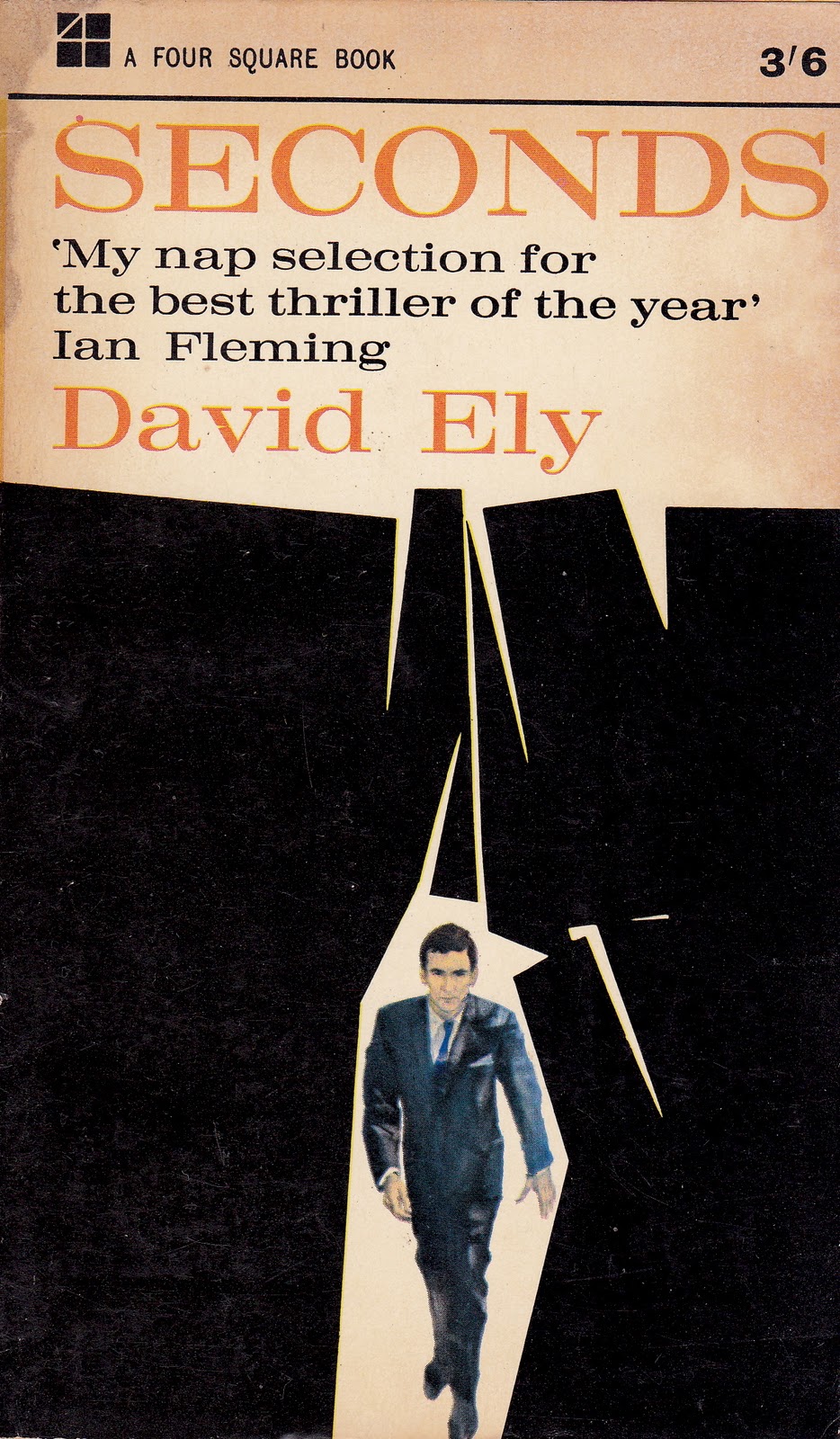
Seconds by David Ely (Four Square 1290) (1965)

New York. Dissatisfied and bored wealthy middle-aged banker Wilson acts on a telephone call from an old college friend and visits an organisation based at an address written on a scrap of paper in the hope of gaining an apparent second chance at life. A random gesture from a rude young man on the street outside the building seems to propel him through the doors and once inside, he is cruelly duped into acquiescing to their services. So, the weary overweight man who enters is replaced by a youthful alter-ego who emerges. A life which seemingly seemed beyond WIlson's reach is now within his grasp, including the availability of compliant young women. However, has Wilson's second chance at life allowed him to enter a Garden of Eden or a Circle of Hell?

David Ely's 1963 novel about rebirth and identity was highly praised at the time by eminent thriller writers Eric Ambler and Ian Fleming (whose favourable quote appears on the cover of this UK paperback edition) and was famously subsequently filmed by director John Frankenheimer. The film was a dark, dystopian science-fiction tale whose stark black and white images, often distorted by fish-eye camera lenses, presented the story more as a horror film with its star Rock Hudson cast against type as the dissatisfied protagonist upon whom it gradually dawns that the grass isn't necessarily greener in the other man's garden.

The novel works more as a dark satire, with its shadowy organisation peopled by ground-down salarymen and run by those with an eye to the bottom line similar to the world that Wilson has left for a seemingly better life.

Concealing its horrors and leaving Wilson's ultimate fate to be discovered by the man himself, the book is in its own way just as chilling as the film adaptation. By locating of its horror in the banal, mundane and everyday, and featuring characters whose voices barely rise above the conversational and whose manners are generally unfailingly polite, the novel conveys a genuine frisson of terror and features a final despairing line that subtly twists its message home like a knife in the guts. Recommended reading, even to those who have seen the film and therefore know the outcome.

VERDICT: First - rather than second(s) - class!

AFTERWORD: Unfortunately, my seemingly elusive copy of the UK paperback edition will not be experiencing the rebirth of the novel's characters as the age-darkened pages have almost all fluttered free from the dried-out spine - which seems rather appropriate. Based on this novel, author David Ely's other novels should be well-worth tracking down. At the time of writing he is seemingly still alive and his latest novel, A Journal Of The Flood Year, was published in 2009.

Thursday, 9 December 2010

The Juvies by Harlan Ellison (Ace D-513)

A strong collection of JD short stories culled from increasingly elusive 1950s magazines or crime digests like Trapped, Terror, Guilty and Web Detective Stories, with the introduction, Ten Weeks In Hell, being the only original writing.

All nine of the stories deal with the 50s sociological phenomenon of the juvenile delinquent, male or female (such individuals had previously existed, but this was the decade they were first labelled as such). All of the stories are stark and realistic in their depictions of blighted social backdrops, ritualistic gang violence and bleak moral outlooks. The gang violence, with its reliance on switchblades, home-made zip-guns or bricks is conveyed with a verisimilitude that places you in the heart of the action, something that Ellison's punchy prose has already drawn you into.

The story Matinee Idyll (which originally appeared as Rock And Roll - And Murder in Trapped Detective Story Magazine in December 1958) is essentially a dry run for Ellison's later Gold Medal original novel Rockabilly and features the same protagonist, but most of the tales will only be familiar to collectors of the increasingly obscure and tough to come by digests in which they first appeared. All of them are recommended both to the author's fans and JD fiction fans alike, although this edition is seemingly as elusive as some of  the original publications in which the stories first appeared.

VERDICT: Gangtastic!

AFTERWORD: I wish I'd reviewed each story rather than just written this seemingly hasty overview. However, this means I'm more tempted to go back and read the stories again, and this shouldn't be too much of a chore as I clearly enjoyed them first time around. Since I wrote this review several years ago, this collection has been reprinted as Children of the Streets (London: Severn House, 2004). Cheap used copies of the Severn House reprint are currently readily available from the likes of Amazon and other sellers at the time of writing, and they will certainly be far cheaper than any copies of the still somewhat elusive paperback original.