Mostly my musings on things vintage hardboiled and noir, literary and filmic and other things that take my fancy. Down these mean streets this man must go...

Sunday, 23 June 2013

The Fiend Who Walked The West (Le Tueur Au Visage D'Ange) (Sidonis Calysta) 96 mins. 42 secs.

Daniel Hardy (Hugh O'Brian) is desperate to secure a financial future for his growing family, so he joins a group of bank robbers. However, the robbery fails to run to plan when Daniel is locked in the safe and arrested, and Daniel's life plans go further awry when he is jailed for ten years rather than the expected shorter prison term he expected as a first-time offender.

Things go from bad to worse when his fellow gang members - whom he has refused to name - fail to provide his family with his expected share of the loot and as he gradually discovers that his young cellmate Felix Griffin (Robert Evans) is an unstable psychopath who exacts a fearful revenge on those who lay their hands on him. However, Felix has plans of his own and, after he discovers the identity of Daniel's gang leader, he decides to secure the loot for himself following his release from jail; which he proceeds to do in murderous fashion. With Daniel on the inside and Felix raising hell on the outside, a plan is hatched by the authorities to ensure that Felix pays for his crime. It's a plan that involves Daniel and his family in a deadly game of cat and mouse.
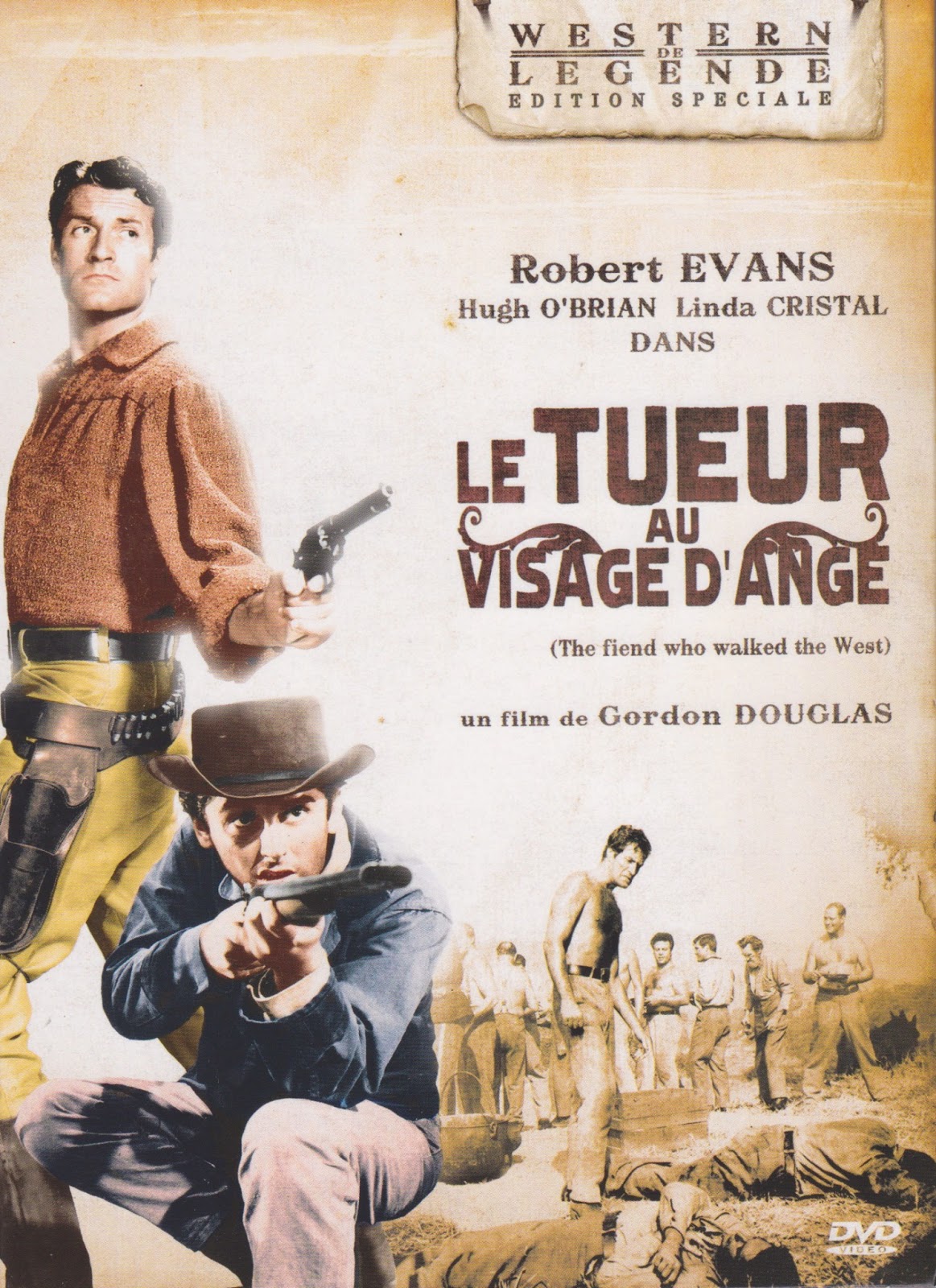
It's Kiss of Death out West as this first remake of the 1947 film noir classic rides the range (there is also a 1995 version starring Nicolas Cage in a scenery-chewing performance as the psychopath whilst David Caruso portrays the similarly slightly tarnished hero). And it's a far more interesting film than it's lowly reputation leads one to believe (a reputation probably due in no small part to a highly misleading advertising campaign from title through poster and trailer that predominantly sell the film as a Western / Horror film hybrid, and which is also cued up by the film's opening titles theme that segues from traditional Western to seemingly supernatural).

Often broodingly shot by experienced DOP Joseph MacDonald, who had previously worked on both Westerns and noirs like My Darling Clementine, Call Northside 777 and Panic In The Streets, and solidly directed by experienced director Gordon (Them!) Douglas from a Harry Brown / Philip Yordan script derived in part from Ben Hecht and Charles Lederer's 1947 script for Kiss of Death (which was itself based on a novel by Eleazar Lipsky), the film is actually a surprisingly successful blending of the style of more adult 1950s psychological Westerns like 3:10 To Yuma and Jubal and the noirish crime cycle that began in the previous decade as the forces of law and order deploy unconventional methods to stop a dangerous criminal in his tracks.

For those aware of the film's derivation, there's a neat and intentional misdirected Kiss Of Death homage in a scene where Griffin encounters the criminal gang-leader's larcenously-inclined wheelchair-bound mother, although the pay-off here reflects the different genre, and, particularly, in Evans' performance in which he occasionally seems to be channelling Richard Widmark's performance in what are often some of the film's least successful moments. It's worth noting that Evans' performance - which the man himself has negatively commented on in his entertaining, if rather self-serving, memoir The Kid Stays In The Picture (both the book and the film adaptation) - is nowhere near as bad as either he, the trailer (in which he gibbers and snarls like a hopped-up 50s juvenile delinquent in scenes that do not feature in the film) or the film's reputation might lead one to believe.

True, the occasional eye-rolling and snarling close-ups contain far less credible menace than Widmark's seminal Tommy Udo. But, in the film's quieter moments and also where his psychotic behaviour is implied rather than played out on screen (the fate of a chain-gang convict who has foolishly previously crossed his path as well as that of a docile and seemingly traumatised female companion who has undoubtedly been subjected to unseen brutality are chilling for what is suggested rather than shown) and where he toys with O'Brian's square-jawed and more instinctive traditional Western hero show that he was a far more accomplished actor than either he or critics within and outside the industry (many of whom resented his seemingly smooth accession to lead actor ranks over others who had toiled for longer and with less success) have been prepared to admit.

The film also balances Evans' more showy moments with solid supporting performances from O'Brian (who was better known at the time for playing Wyatt Earp in the long-running TV series The Life And Legend Of Wyatt Earp), Stephen McNally, Dolores Michaels (who subsequently starred in the unusual and little-seen Alan Ladd revenge Western One Foot In Hell), Linda Cristal (as O'Brian's wife and who achieved more notable success in a similar role in TV Western series The High Chaparral), snarling stalwart Emile Meyer ('fat cop' Harry Kello from Sweet Smell Of Success) and future TV Tarzan Ron Ely as a Deputy with a hair-trigger temper.

Overall, it's a film undeserving of its consignment to date to a critical backwater and, hopefully, this sharp French DVD 2:35:1 transfer that maintains the original Cinemascope ratio (and which is English language with forced French subtitles) may herald a US or UK release, possibly with a subtitled version of the two add-ons, one of which features French director Bertrand Tavernier who - based on my limited understanding  of the French language - appears to be providing some long-deserved critical rebalancing. It's certainly no masterpiece, but there's much to recommend it, and far more than the laughably conceived trailer that also features on the disc.

AFTERWORD: Now that you've seen what is probably one of the reasons why the film is generally held in such low regard, please check out the film. I don't think you'll be disappointed.

Saturday, 22 June 2013

End Play (1975) (Umbrella Entertainment) (108 mins.)

Someone is killing female hitchhikers on a lonely stretch of road outside a small Australian town. Although the victims are all neatly stabbed below the breast bone, the murder weapon is unknown and the victims have so far been dumped on the police station tempts to taunt the local force. However, the latest victim (Delvene Delaney) is not left in the usual place and is instead dumped in a local cinema during an afternoon screening. Suspicion soon falls on two brothers, paraplegic Robert Gifford (George Mallaby) and his able-bodied brother Mark (John Waters, who is NOT the well-known film director) who has recently returned home from one of his frequent stints in the merchant navy. The brothers have a close relationship but, as suspicious Superintendent Cheadle (Ken Goodlet) begins his investigations, cracks start to appear as the persistent and diligent officer seemingly gets closer to the truth at the heart of the serial slayings...

Director Tim Burstall's 1975 Australian serial killer thriller, released in its native country on 1st January 1976, adapted from a novel by Russell Braddon (The Naked Island and The Year Of The Angry Rabbit, which was filmed as Night Of The Lepus) and which relocates the action from an English country house to an Antipodean setting, is a taut if rather overlong thriller that plays out mostly in broad daylight and predominantly in the Gifford's home; which lends the film a claustrophobic two-hander chamber piece feel for much of its running time.

Opening with a tense and atmospheric killing on a lonely road, Burstall winds the tension tight, aided by some fine performances from the two leads whose relationship remains the beating heart of the movie even as the plot bends over backwards to maintain the uncertainty as to the killer's identity (which, if truth be told, is not really that much of a mystery). And it's the brothers' often unlikely bond throughout the film that makes the film memorable as blood really is thicker than water in what is admittedly rather protracted, if tense, fare. The film even manages to excuse itself one or two plot contrivances or unresolved aspects (most notably, a bit of business with a letter that is only written to provide a necessary flashback and whose existence is never followed through in the narrative).

Overall, this is a worthwhile watch and a generally fine re-release package in a clean print and in its original aspect ratio (although the soundtrack is a bit iffy at times, particularly during the mournful and plaintive love theme sung over the opening credits). The film, which was seemingly Australian cinema's first foray into serial killer whodunit territory and a box-office hit in its native country, deserves to be better known and is highly recommended.

AFTERWORD: This standalone Australian DVD release is a more affordable and accessible release than its original inclusion as part of a long-deleted and almost impossible to find boxed set. I first saw the film several decades ago as part of a UK BBC2 TV season on Australian cinema back in the 1970s (Those were the days!) and was surprised how much of the film stuck in my mind over the years. Although British-born director Tim Burstall was better known as one of the pioneers of Australian cinema's 1970s breakout to global success through some often rough and ready sex comedies (e.g. Stork, Alvin Purple and Petersen), this films shows that he was no slouch in the thriller stakes and it's something of a pity that he never made much of a name for himself in this genre.

The special features on the disc include interviews with star John Waters, cinematographer Dan Copping and Burstall's son Dan, who was the camera operator (and whose inclusion is not mentioned on the DVD sleeve), as well as an effective and rather extended trailer and stills gallery backed by the theme song, with both of the latter elements revealing rather too much of the film's plot to be recommended viewing prior to watching the film itself.

Sunday, 28 April 2013

Take My Face by Peter Held (Pyramid Books G327) (1958)

Thirteen year-old Robert Struve is facially disfigured whilst riding a borrowed motor scooter which is struck by a car being steered by eight year-old Julie Horvard who is sitting on her father's lap. His impoverished mother settles for a low insurance pay-out and Robert completes his high-school education, where he excels as a football player. However, after he is invited to a sorority house initiation, he attacks Julie when he discovers he is the butt of a prank in which Julie and her sorority sisters Cathy, Dean and Lucia are meant to make out with him. Robert is sent to reform school where he finally receives plastic surgery to change his appearance.

Five years later, Dean is murdered in San Francisco shortly after telling her brother Carr that she has recently met Robert. Although her husband George confesses, Carr is convinced that Robert is seeking revenge for his earlier mistreatment and when it seems that the same killer is targeting the remainder of the female quartet, it appears that he may be correct...

This is the only novel written under the pseudonym Peter Held by Jack Vance (John Holbrook Vance) - an author more noted for his science-fiction and fantasy stories. In spite of the brutal but effective cover art by John Floherty and the front and back cover text, this is a murder mystery rather than an early serial-killer thriller, as much of the narrative focus placed on the character and motivations of the young women seemingly being lined up for the kill by a vengeful murderer as well as on the
identity of the killer.

The small-town setting with its formal collegiate rituals and codes of behaviour clearly belong to another time and place far removed from the contemporary scene, but these are nevertheless strongly evoked. So is the tension, which quietly builds, juxtaposing the murderous and the mundane - and the macabre - in a manner that keeps the reader off guard whilst rapidly turning the pages in what is a short, sharp and fast read.

There are some clever twists, including a major one which means this review must give away as little as the novel itself; even though it is one that has been oft-repeated since and most recently in a highly-regarded US TV show. Overall, this is a satisfying read, well-paced and written with a keen eye for detail and is therefore recommended if you're fortunate enough to find a copy.

AFTERWORD: And if you're fortunate enough to find an affordable copy of either the Pyramid paperback edition above or the original and extremely scarce 1957 Mystery House hardback you will be fortunate indeed. However, the book has since been republished under Jack Vance's name in a limited edition by Underwood-Miller in 1988 - which means copies seem to fetch extremely high prices - and also as The Flesh Mask (which is apparently Vance's preferred title) in a 2002 Vance Integral edition. My copy was more affordable as it was purchased as part of a job lot of Pyramid titles, and which at least made it relatively inexpensive compared to buying a single copy.

Monday, 1 April 2013

Keep Talking Baby (86 mins) Original Title: Cause Toujours, Mon Lapin

Jackson the ventriloquist (Eddie Constantine) is sentenced to twenty years in solitary confinement. However, prison bars cannot hold him for long and he quickly breaks out, returning to his Parisian haunts in search of a woman called Francoise whom he believes can provide him with an alibi. However, Francoise is shot and injured by gang members working for nightclub owner and criminal Simon. As she lies injured, Francoise tells Jackson to recover her daughter Sophie from a hotel room where she has been hidden. However, Simon's gang are on the trail, so Jackson and Sophie have to keep one step ahead of Simon and his gang whilst Jackson seeks to clear his name.

This is a lame, pedestrian and poorly motivated adaptation of Day Keene's superior crime novel Strange Witness (see previous entry). The tin-eared dubbing doesn't help, but it's the radical narrative alterations that hobble the film so that it limps to an unsatisfactory end. Setting aside the narrative ellipse at the start that fails to explain how Jackson breaks out of solitary confinement, one is still left with the red herring Sophie.

Rather than being a deux ex machina who could provide Jackson with the alibi to save him, Sophie serves no narrative purpose whatsoever, and neither does the large stuffed rabbit she insists Jackson buy for her; unlike in the novel where it provides for a key plot twist. Featuring one of the least exciting cinematic car chases, the type of wimpy hoods who hand over information after one light slap to the face, compliant women who find Hart so irresistible that they fall for his charms almost as soon as he opens his mouth and a plot that is mostly tell rather than show (the 86 minutes really do crawl by), and one is left with a highly unsatisfactory adaptation that fails to do any kind of justice to its fast-paced - if not exactly flawless - literary origins.

AFTERWORD: Although his literary output was prolific, Day Keene's work was not well-served by screen adaptations as surprisingly few of his books have been filmed. Apart from this film, Rene Clement's Les Felins (aka The Love Cage and Joy House), which was based on Joy House, and the Elvis Presley vehicle The Trouble With Girls, and which was adapted from Keene and Dwight Vincent's novel Chautauqua, are the best known. The film's Belgian poster - which I have scanned in from my collection - is more atmospheric and evocative than anything in the film, which is available as a VoD DVD-R from Sinister Cinema, and whose sound and image quality are serviceable enough.

Sunday, 31 March 2013

Strange Witness by Day Keene (Graphic Books 58) (1953) (PBO)

Former nightclub entertainer Hart Jackson leaves prison after serving seven years a for a crime he didn't commit, having taken the rap for a frame-up that had ensnared his brother. Hart is now determined to kill the man responsible, Chicago crime lord and night-club owner Flip Evans. However, he rapidly becomes ensnared is a surprising series of events after meeting nightclub singer Thelma Winston, who claims she can clear Hart's name.

Thelma insists that Hart marries her before she is prepared to put in writing what she has told him, and she offers Hart some much needed cash with much more to follow if he agrees to her demand. the pair marry and arrive in Chicago, but they have been followed, Thelma is shot and badly injured and Hart is suspected of her shooting. Before going on the run, Hart is assured by Thelma that she hadn't set him up and is urged by her to take care of Olga, who is currently in a local hotel room. But who is Olga, what does she know and can she help Hart get out of his increasingly dangerous predicament?

This is a pacy, if slightly implausible, paperback original noirish crime melodrama that barely lets up from the first page and whose headlong narrative makes one overlook much of its narrative contrivance. The pieces all come together neatly - possibly rather too neatly - and there are also one or two clever twists, including one which I didn't see coming and had to turn back the pages to work out how it happened and whether it made sense (it does).

The bleak atmosphere of a seedy and Wintry Chicago is well-evoked within a novel where there is little or no narrative fat, the occasional violence is often realistic and painful and Keene spins a short, sharp,taut and twisty yarn with some flair and an eye for character, locale and a neatly turned phrase that keeps one turning the pages. Overall, it's a recommended read, if not perhaps one of its author's best.

AFTERWORD: Day Keene (real name Gunnar Hjerstedt) was one of the top paperback crime writers of the 50s. Having started in the pulps, Keene penned around fifty novels, as well as writing for film, TV, radio and the aforementioned pulp magazines. His books are generally distinguished by a direct writing style, and fast-paced - if occasionally implausible plots (I failed to mention that the hero of this one is also a ventriloquist whose voice-throwing skills have a direct bearing on the narrative and make him probably the finest exponent of his craft who never lived).

Many of his novels, like this one, feature a male protagonist on the run fighting to clear his name from a crime he did not commit and appeared between the covers of the popular paperback and digest publishers of the day (for example, Gold Medal, Graphic, Pyramid, Avon, Ace, Zenith, Lancer, Phantom Books).  Author Bill Crider - who has written about Keene in far more detail and with more knowledge and insight than I can offer - is a fan and, if you read one or two of his 50s crime novels - some of which have recently been reprinted by the likes of Hard Case Crime and Stark House Press - I am sure you will be too.

This one has been reprinted by Macfadden Books in 1970 (an easier edition to find than the Graphic Books PBO) and in large print by Linford Library in 1991. It was also filmed in France in 1961 as Cause Toujours, Mon Lapin, with a dubbed DVD-R version (presumably the US release version) available from Sinister Cinema as Keep Talking, Baby (see the next entry).

Monday, 12 November 2012

The Sweat Of Fear by Robert C. Dennis (Arrow Books) (1975)

One night, successful architect Paul Reeder sees a terrified girl running for her life in a quiet suburb. The problem is, he wasn't there at the time. Paul has only seen the crime after receiving images from a compact mirror he picked up after it was dropped by a woman in the foyer of his office building. And this fortunate - or unfortunate - intervention leads Paul to discover that he is psychic. However, his new gift - or affliction - involves him in a recent unsolved murder and a cast of characters including the members of a hippy cult that doesn't appear to practice peace and love, a reluctant witness and a killer (or killers) who resent the appearance of an amateur detective with a seemingly other-wordly gift.

This early 70s murder mystery whodunit promises much but delivers little. The psychic aspect of the plot is never explained and is apparently randomly acquired. So, instead of adding an exciting extra dimension to the narrative this merely results in Paul attempting to get his hands on some trinket or other in order to receive a psychic charge and advance the stuttering plot. This means the novel is repetitive and pedestrian and also becomes progressively less interesting given the similarity of these narrative building blocks.

It's possible this might not matter as much if the characters were quirky, vivid and leapt off the page - or if the author worked hard at evoking a time and place in which to immerse the reader. Unfortunately, the characters are cardboard, and location and incident bland to the point of tedium. So, in spite of a neat and rather cynical twist in the tail - which was a not uncommon narrative device at the time - there is little to engross or entertain and even less of a charge (psychic or otherwise) to convince the reader that there is more to this formulaic whodunit with a fantasy twist than meets the eye.

AFTERWORD: I was previously unaware of author Robert C. Dennis, but some amateur online sleuthing - unaided by any psychic insights - reveals that his literary career was far eclipsed by his screenwriting career. This was both lengthy and prolific, lasted from the early 50s until his death in 1983, and predominantly involved TV series like Alfred Hitchcock Presents, The Untouchables, The Outer Limits, Hawaii Five-O,  Kojak, Charlie's Angels and T.J. Hooker.

Unfortunately, this novel exhibits the worst aspects of stolid and stereotypical TV genre writing of the day and the author's predominant employment in TV scriptwriting suggests that this was his strength. This UK paperback edition (there was an earlier UK Gollancz hardcover) was acquired for pennies rather than pounds along with a batch of 60s and 70s UK horror paperback fiction at a sadly since closed local charity shop. It boasts evocative - if slightly cheesy - uncredited artwork which suggests the book is a stalk and slash horror novel rather than this disappointing and forgettable whodunit.

Saturday, 27 October 2012

The Cult Of Killers by Donald MacIvers (Leisure Books 364DK) (1976)

Donald MacIvers (or 'Mac', as he is known to his friends) is scared. A Harvard drop-out hooked on drugs, booze and sex, Mac has been indoctrinated into a murderous cult influenced by Charles Manson. This cult of killers murder  at will and at random in 'a war to the death, a fight to the finish' fuelled by the deranged belief that this will initiate an anarchic free for all from which they will emerge triumphant and omnipotent. Led by the diminutive Crazy Mary and assisted by her her murderously adept sidekick Esmerelda, the cult have pushed Mac to the end of his tether and a point at which he will no longer participate in their murderous plans. So, seizing on the chance to flee, Mac makes a run for it. However, he soon finds that the cult's tentacles stretch far and wide, and that not even help from such unlikely sources as a wealthy gay pick-up, an amenable young prostitute or even organised crime can seem to shake his former associates from their vengeful path...

An exploitative, sleazy 70s urban chase thriller scribbled in the shadow of symbol of the 60s meltdown. This dubious effort is a grimy, melodramatic and fast-paced 'X'-rated race through a nightmarish night-world that occasionally releases a seemingly authentic 42nd Street Grindhouse odour reminiscent of the celluloid revenge epic The Exterminator (1980). Ludicrously pitched to an almost hysterical - and often hysterically reactionary - level of heightened realism, this evocation of society's squalid underbelly is undoubtedly effective and the novel is undeniably a page-turner. However, it is also ludicrously implausible with the pursuing cult members inexplicably able to repeatedly reach their tentacles into Mac's most obscure hiding places without any plausible explanation, beyond the fact that Manson himself may be supernaturally divining Mac's whereabouts and telepathically communicating them to his deranged acolytes from his San Quentin prison cell.

The sexual politics of the book are hardwired to the times it was written, and the grisly fate of a knife-wielding female cult member who is shot by Mac several inches lower than her knife hand tells the reader all one needs to know about the ideologically soundness of the narrative set-up in which its female characters are at worst psychotic nymphomaniacs and at best helpful hookers. However, this determinedly downbeat tale actually plays out like a more graphically violent, sexually explicit and overtly misogynist update on a 50s Gold Medal original template spliced with The Fugitive.

So, for those who wish to be transported back to the world of seamy 70s paperback originals, this undoubtedly provides a couple of hours of rough hair-chested macho thrills; and is certainly the type of generic throwback which wouldn't stand a chance of getting published in these more politically correct times.

AFTERWORD: This is a curious package insofar as the cover blurb ('The horrifying revelations of a fiendish, sadistic murderer') and artwork featuring a well-drawn and convincing likeness of Charles Manson lording it over a poorly rendered sacrificial rite that may have been produced by a different artist suggests that this may be another non-fiction cash-in on the notorious real-life crimes associated with Charles Manson and his 'Family'.

The back cover also suggests that the novel may be derived from real events ('The author, formerly a member of the group, now in hiding, has revealed that the worst fears of the police were true. This is the whole sordid story'), although it also refers to the cult 'killing the female actress in a S&M flick'; an incident which does not even feature in the book.

Given this misdirection and the fact that I have been unable to ascertain anything about author Donald MacIvers beyond the fact that he is accredited with an introduction to a 1973 Leisure Books title Kothar - Barbarian Swordsman by Gardner F. Fox, this curious tangential addition to post-Manson literature is best enjoyed less for its tenuous links to that subgenre and more for its grubby generic thrills.