Mostly my musings on things vintage hardboiled and noir, literary and filmic and other things that take my fancy. Down these mean streets this man must go...
Harry London has sunk almost as far as he thinks he can go. After finding his wife Lucy in flagrante with local lothario Dick Stewart (and that first name is clearly apposite!), the ensuing melee leaves Lucy dead and Harry covering up his apparently murderous act. However, when a woman called Jean Cummings - who knew Lucy prior to her marriage - unexpectedly arrives at Harry's shack, the wheels are of revenge are set in motion.
However, can Harry - who is now deeply mired in alcohol, disgust and self-loathing - trust Jean or himself, or will hate drive them even deeper into a hell of their own making?
It's probably best to conceal the majority of this narrative, which twists and turns in often surprising fashion before a rousing climax in which all is finally revealed.
Essentially, this is a character study concerning rebirth and redemption, and one that is cannily plotted and tightly told. The novel literally begins with a bang - well, actually, it almost begins with a rape that further tarnishes the already besmirched Harry. However, every incident provides depth and motivation - even if it doesn't quite jibe with our more politically-correct times - in a tale that grips as it goes due to fine, evocative writing that vividly portrays a time and place, as well as charting the path to possible salvation of a man's soul.
It's fine, muscular stuff that's both hardboiled and noirish, embodies the best of the 1950s Gold Medal paperback original style, and is therefore a book that comes highly recommended.
AFTERWORD: Paul Connolly was a pseudonym for New York Times political reporter and columnist Thomas Grey "Tom" Wicker, who wrote this novel and two others, Get Out Of Town and So Fair, So Evil for Gold Medal in the early 1950s. I haven't read the other two Gold Medal titles, which are rumoured to be the lesser of his trio. However, on the basis of this one, they are probably worth reading, with Get Out Of Town being seemingly tougher to find than the other pair. The cover art for this one was drawn by the prolific Barye Phillips.
England, 1969. Patrick Norval is a widower in his early forties who has a tedious job as an insurance clerk. However, he also has a teenage son called Bob who might just be the next big thing in the world of pop music. Patrick is understandably concerned at the prospects of his son being manipulated, used and abused in a world that he believes to have few scruples or morals. However, Bob's manager, a canny and seemingly insincere young Australian called Brian Boru O'Brien - a man who makes no bones about the fact that he is in it for the money - suggests that Patrick tag along with his management team and the band to ensure that Bob comes to no harm on a forthcoming tour of the USA. Brian believes that Patrick's well-publicised presence on the tour will show that Bob is a different kind of star, a young man who can demonstrably bridge the perceived 'generation gap'.
So, having resigned from the insurance company, Patrick finds himself seemingly adrift in a world in which he has little interest, knowledge or understanding. But he soon learns, and maybe those on the tour can also learn something from him...
Prolific Australian writer Jon Cleary's timely late 60s novel about the contemporary music scene was a radical and unlikely departure from an author better known for his long-running detective fiction series featuring Sydney Police Inspector Scobie Malone (and which began with The High Commissioner in 1966) and various adventure novels, some of which were adapted into films. This stand-alone novel is a well-crafted page-turner that predominantly views events through the eyes of middle-aged Patrick as his eyes are opened to a world of excess all areas, albeit one that is described in restrained fashion and even comes across as rather quaint when compared to the reported extremes of subsequent eras.
This is essentially a character study of a man who is well aware he is taking a break from his mundane life, and the book is particularly effective in showing his benign influence on those around him; particularly Brian, a Machiavellian Andrew Loog Oldham type who may not be as cynical as he first appears. Indeed, the ability to impart an often unlikely humanity and surprising likability to many of its characters is one of the book's great strengths.
However, this is no rose-tinted view as Cleary's literary radar is sharply tuned into both the generation gap issues and the ability of people to both be taken in by appearances and consequently be exploited. Also, the band's cynical arranger, a man resentful of others' place in a spotlight he believes to be rightfully his and the occasional hypocritical hippies come in for some sharp and trenchant jabs from the authorial pen.
This, then, is a far better and more profound read than the New York Times' grouchy critic at the time claimed when he claimed that "it is evident that the pop music scene is not an lement in which Mr Cleary is very comfortable. His narrative skills are squandered on a frail recipe that lacks his customary involvement".
So, although not the usual type of hardboiled fare I cover in this blog, this is nevertheless recommended as a still relevant and well-told morality tale.
Oh, and if you're wondering about the relevance of the title, some basic internet sleuthing reveals that Jack Hoxie was indeed the movie star whose career flourished from the silent film era through the 1930s, as claimed in the novel by an elderly friend of Patrick's. The fact that this once famous man is unknown or forgotten by everyone else in the novel - and, I'd wager, most people who read the novel or this review - is the potent metaphor for the novel's perceptive take on the often temporary nature of fame and celebrity.
AFTERWORD: This is the first Cleary novel I've read and, although it's clearly an atypical one, his storytelling skills, humbly and self-effacingly summed up by the writer himself in a 1998 interview when he said "I realised at 40 I did not have the intellectual depth to be the writer I would like to be, so I determined to be as good a craftsman as I might be", were clearly formidable. On this showing alone, he was obviously a talented writer with the knack of spinning a yarn and holding the reader's attention (well, this one's anyway) and his relative obscurity in the UK these days is both unfair and regrettable. I found this UK dust-jacketed hardback priced at 50p in a local charity shop and both this edition (usually ex-library copies), the UK Fontana paperback and the 1969 US Popular Library edition with a more psychedelic artwork cover featuring a Frank Zappa lookalike and rather hyperbolic cover tagline "The underground smash! A novel that turns you on to the freaked-out world of rock!" are currently readily - and fairly cheaply - available on internet used book sites.
Experienced confidence trickster Sam Carter meets young would-be grifter Mavis Train at the Beverly-Wilshire hotel. Rapidly realising that the inexperienced woman is just who he needs to con an older woman, he takes her under his wing for a series of cons. However, Sam is a spendthrift who rapidly burns through the money he makes and realises he needs to make bigger scores. So, after marrying Mavis, he sets his sights on lonely women in search of marriage and plans to relieve them of their funds and leave no trace behind. The cons now involve Mavis posing as Sam's sister, but they also turn deadly as they also involve murdering the hapless women who fall for Sam's charms, with the killings staged as accidents to allay suspicion. Repeatedly changing their identities and moving around the country, the couple soon have a murderous template established, but have they been careful enough?...
Clearly based on the case of the real-life "Lonely Hearts Killers" Raymond Fernandez and Martha Beck - who were also the subject of the films The Honeymoon Killers and Deep Crimson - this is a fast-paced and gripping read; albeit one with a sting in the tail that I saw coming several pages from the end. Hard-bitten and hard-boiled, the 160 pages turn rapidly as the dark tale unfolds, with characters, situation and place economically evoked as the story barrels along in a manner reminiscent of the best of Harry Whittington and Gil Brewer. This is the type of paperback original with barely a word wasted that epitomises an almost vanished narrative style, and is one that a lot of overwritten and overwrought contemporary genre fiction could learn from. Therefore, it is highly recommended to fans of period hardboiled paperback originals; as this is what they were all about at their best.
AFTERWORD: Most of what I know about author Richard Deming, I know from the fantastic reference guide Paperback Confidential: Crime Writers Of The Paperback Era by Brian Ritt (Stark House Press, 2013). Although I was previously aware of his series character Manville "Manny" Moon, a private detective who occasionally featured in the pages of the crime digests like Manhunt, and the Mike Shayne and Alfred Hitchcock Mystery Magazines, and I also own some other Deming books I have yet to read (I own a LOT of books I have yet to read!), I was not previously aware of his many pseudonyms and short stories. Based on the entry in Paperback Confidential, it appears that Deming may be better known today (if at all) for the many TV tie-in paperbacks written under his own name and the pseudonym Max Franklin for such shows as Starsky And Hutch, Charlie's Angels and Vegas.
However, based on this wonderfully entertaining literary jab to the solar plexus, I should get started on the other Deming books I own; and you should certainly get started with this one. I don't think you'll be disappointed and, based on a current internet search, there are a few reasonably priced copies of this one - and other Deming titles - available; although the UK Digit Books edition of Kiss and Kill (R438) shown above, and from the same publication year, seems to be a tougher edition to find.
Lee Baron is an inexperienced Florida private detective who swiftly finds himself immersed in an increasingly complex and violent series of events after he is visited by an old flame called Ivor Hendrix. It appears that Ivor wants Lee to smooth things over between her and her husband Carl after he has caught her in a compromising position with another man. However, when Lee arrives at the Hendrix residence, he finds a man's armless corpse with its face caved in, as well as some evidence that suggests the victim was involved in a recent unsolved bank heist. From here, the incidents pile up in fast and furious fashion as the corpse vanishes, potential suspects arrive on the scene - including Ivor's voracious sister Asa Crafford - and Lee finds himself dodging the bullets whilst barely suppressed romantic yearnings for Ivor re-emerge and things get progressively murkier, as well as murderous...
Boasting two femme fatales and fast and furious action, Gil Brewer's Florida noir private eye novel should be more exciting and gripping than it is. Although the events barrel along at a rapid clip, they progressively loosen their grip on the reader's interest due to formulaic plotting and disappointingly one-dimensional characters who present more as types than people. Lee is a cliched lone wolf private eye of a kind that must have seemed derivative even in the late 50s when Mike Hammer knock-offs were plentiful in both hardcover and paperback original genre novels.
The pair of femme fatales are similarly generic archetypes (and for British readers their masculine-sounding first names can be rather jarring and distracting), and supporting characters generally lack both depth and shading. The twists and turns of the plot just about maintain interest and there is a rather clever twist in the tail - albeit one reliant on some criminal types failing to case a residence thoroughly enough - and the occasional brutality and hard-edged violence add a much-needed air of menace to the proceedings.
However, Brewer seems to be on autopilot for much of the novel, deploying often clunky metaphors amidst some surprisingly flat patches of writing. Overall, this is a rather mechanical, one-dimensional disappointment from an author who was clearly capable of delivering far better hardboiled or noir novels, most of which were paperback originals that epitomise the best of the breed. Newcomers are best advised to begin their Brewer browsing elsewhere (13 French Street, A Killer Is Loose or The Red Scarf are my preferred starting points), as there is plenty of good stuff to uncover from an author who, when he was writing at his peak, was amongst the best of his kind.
AFTERWORD: Gil Brewer is one of my favourite hardboiled crime writers of the 50s and 60s, although his earlier books generally eclipse much of his later work when his powers were clearly waning. However, Wild presumably sold well enough at the time to justify the mid-60s Gold Medal printing shown above, even though it may have seemed rather dated even only seven years after its appearance as a paperback original (and I'm not just referring to a Marilyn Monroe reference) as private eye novels were by then being refined by the likes of Ross and John D. MacDonald.
Brewer's decline was almost certainly due to his well-documented increasing dependence on alcohol and possibly related bouts of depression (his final books included pseudonymous porn novels written when the markets had changed and left him short of paid work that seemingly didn't pay him enough to provide a secure and stable living); although there are still some diamonds to be found in the rough of his later output.
At their best, his books are capable of immersing his readers in an often bleak world view, predominantly one fuelled by characters' sexual obsessions that define their destiny (happiness is generally a commodity in short supply). Brewer also wrote some wonderful crime short stories that resemble short, sharp literary jabs rather than the relentless pummelling that his novels often deliver.
As many of these, some of which were written pseudonymously, were previously uncollected and often only available in increasingly expensive crime fiction digests (for example, Guilty, Hunted, Manhunt and Pursuit Detective Story Magazine, amongst many others), I can highly recommend Redheads Die Quickly (University Press Of Florida, 2012), which is edited by David Rachels. This collection of many of the best of Brewer's short stories, includes a bibliography of his short fiction and an introduction by Rachels to Brewer's life and work that explains why his writing is essential reading for all fans of classic hardboiled crime and noir fiction.
Jake Abbott is an impoverished journalist in trouble in post-War Italy. Desperate to extricate himself from an art forgery scam he is involved in, Jake escapes his larcenous employer Turrido by beating him up, simultaneously humiliating him into the bargain. Now, with Turrido's youthful protege Angelo on his tail and eager to prove himself to his employer, Jake is flung out of the frying pan and into the fire when his editor Ralph Ellison sends him to a small town called Piscoli which is threatened by a raging flood.
However, the story isn't the only thing waiting there for Jake. Pursued by Angelo, who is eager to make a name for himself, Jake is surprised to find Ellison's wife Grace - with whom he has been having an adulterous relationship and who has worked her passage to Piscoli by offering assistance to a man called Leverett who has been sent by the Italian-American Assistance Committee to supervise aid - as an unwelcome companion. Accompanied by his photographer friend Harry Myers, Jake arrives in the small town of Asceno on the way to Piscoli, but here the raging floodwaters deny the group the chance to reach their intended destination.
And, when Jake becomes further embroiled in some of the town's guilty secrets, which included a valuable lost stash of jewellery and rare paintings that are uncovered by the floodwaters, this unlikely knight in tarnished armour finds himself trapped both by a natural disaster and a series of mortal foes, any of which could bring his life to a violent and premature end.
This is full-tilt action-adventure melodrama, and one that has the reader tearing through its pages like the flood raging through the town. The excitement barely lets up throughout the 144 pages, the plot twisting and turning in imitation of the the raging torrent of the title, barely allowing one time to ponder the inevitable implausibilities (not the least of which being a seemingly indestructible hero who takes repeated brutal beatings at the hands and feet of various adversaries, but who seems to suffer few lasting ill-effects).
So, this is almost a quintessential paperback original of its time, featuring swift, sharp descriptions establishing time and place, thumbnail character sketches telling you all you need to know about motives and morals and effectively concealing its mystery until the hero figures it out in the final chapter. Of course this isn't great literature, but it's brisk, well-crafted and solid entertainment that delivers the requisite square-jawed, two-fisted action and hardboiled murderous criminality in a two-hour jolt; as well as one that doesn't waste its words or its readers' time in doing so.
AFTERWORD: Malcolm Douglas was a pseudonym for Douglas Sanderson and is the subject of an excellent and thorough article "Douglas Sanderson: Pure Sweet Hell" by Gregory Shepard which features in Paperback Parade Issue 84 (and if you don't subscribe to editor Gary Lovisi's excellent and essential publication, I recommend you head over to http://www.gryphonbooks.com/Paperback_Parade/Paperback%20Parade%20Back%20Issues.htm and take out a subscription).
This book had previously languished unread in my ever-increasing "To Be Read" pile for several years since I bought it, and the aforementioned article compelled me to crack open its covers and rectify this omission. I was glad I did and now intend to read more of the author's work. At the time of writing, there are a few copies available online at reasonable prices (there is also a UK Gold Medal edition from 1960 that seems to be rather more uncommon than the US paperback originals), so I recommend you pick one up and let this "Rain" wash over you.
Dr. Hans Kuperus is well-respected in the small town of Sneek. His life is well-ordered, he has a seemingly happy marriage and lives prosperously in a well-appointed house. However, he has received a letter informing him of his wife's affair with a local dignitary. So, Kuperus buys a gun and kills his wife and her lover, returns home feeling liberated from his cuckolded status and takes his maid as his mistress. The townspeople's initial sympathy towards Kuperus gradually turns to suspicion and, finally, to outright hostility as they suspect Kuperus murdered both his wife and her lover after the bodies are discovered in the canal. However, Kuperus has covered his tracks well but is now beset with fear of discovery, particularly as the sender of the letter also knows of his wife's infidelity and may now know he is the murderer. But who sent the letter, and what do they intend to do with their knowledge?
Georges Simenon's 1937 psychological mystery still feels surprisingly fresh and modern due to the accuracy of its observations (human nature has not seemingly changed that much) and the economy of its prose style as neither a word is wasted nor a scene superfluous to the narrative. It's essentially a tale of small-town moral inquiry of the type frequently filmed by Claude Chabrol (e.g. Le Boucher, Juste Avant La Nuit), and is one where the murderer's identity and motives are clear from the start.
The source of tension and mystery are the external and, ultimately, internal forces that are beyond the control of Kuperus as the novel addresses issues of guilt, identity, personality and small-town hypocrisy where a watchful or disapproving look can be more devastating than an act of violence. The writing is crisply evocative of both place and character, and is particularly effective in describing the claustrophobic sense of the darkness gathering and closing in as a man who believed he has found freedom instead finds himself trapped in his own circle of Hell.
There's also some surprising humour too, albeit often of a dark variety, and also a strong sense of a satire on conformity and of a particular type of middle-class small-mindedness - that of the curtain-twitchers and suburban passive aggressive personalities who know just how to needle, cajole and threaten in covert fashion in a town where the appearance of respectability is everything. Effectively building sympathy for an unsympathetic character - a murderer, in fact - this is a highly recommended, short, sharp jab to the psyche by an author who knew how to twist the knife in, slowly and without recourse to flamboyant or florid prose.
AFTERWORD: Belgian writer Georges Simenon was a prolific author who wrote around two hundred novels and many short stories, with his most famous creation being detective Jules Maigret, who featured in films and a famous UK TV series. Many of Simenon's novels have been reprinted in the last few years, and second-hand copies are generally freely available on the internet, second-hand bookshops, charity shops and elsewhere. They seem particularly plentiful in the UK where they were extremely popular in the 1950s and 60s due to the Maigret TV series raising the author's profile.
My copy of this book was one of several I recently acquired in a local sewing shop whose elderly owner has acquired a Kindle and was selling off her collection cheaply (she seems to have bought many of them in various outlets of the late lamented Popular Book Centres which used to trade in London until the late 1980s as their stamp appears inside most of them). So, there is no excuse for not stocking up on Simenon, which is something I highly recommend as I can't wait to get started on the next one.
One day, writer David Newton meets Peggy Lister on a deserted Los Angeles beach and is instantly smitten. However, Peggy seems somewhat remote and troubled - as well as being a self-confessed man-hater - and also appears to have something to hide. She reveals little to David about her past, except for snippets about her seemingly dysfunctional home life, but David is still keen enough to start dating her. When she invites him to a party, David is surprised to discover that the host is a former college acquaintance called Jim, who is now a successful lawyer and less than happy to see David as he too has designs on Peggy, even though he is still married.
After David and Peggy are attacked by an unseen assailant during one of their dates at an amusement park and her landlord - whom Peggy suspects of the seemingly sexually motivated assault on her - is found dead at her rooming house after being stabbed through the brain with an icepick, David finds himself embroiled in an ever-deepening mystery. It is a mystery that seemingly has its roots in Peggy's past, but who is the killer, is he or she also responsible for a further slaying, and will David become another victim?
Richard Matheson's debut novel, published when he was twenty-six years old, is a fast-paced noirish mystery, with strong elements of both the whodunit mystery novel and psychological drama. This novel is not perfect by any means as some of the characters, particularly the protagonist, present more as types than flesh and blood characters.
However, the narrative whips along at speed (possibly, a welcome legacy of the author's pulp magazine origins), particularly towards the end, which means that the flaws are more forgivable and less noticeable than they would be in a novel that features excessive narrative digressions or pace-killing exposition that impede the narrative flow. Some scenes, particularly a thrilling extended night-time chase towards the end, really stir the blood and the novel's final page wrap-up and chilling last line leave the reader enveloped by darkness rather than a sense of emerging into the light (just like the best 50s paperback originals).
Overall, this is an impressive first effort, and one whose implausibilities of plot and situation (for example, David seems to sober up remarkably quickly after an extended drinking binge that would put most people in an alcohol-induced coma) are less important than its swift storytelling and atmospheric evocations of a threatening world where nothing and no one are quite as they seem. Therefore, this is a recommended introduction to an author who improved with each novel and whose influence continues to be felt in genre literature to this day.
AFTERWORD: Your best bet to find a reasonably priced edition of this title would be to search for the 2005 Forge omnibus edition which includes the author's later novels Fury On Sunday and Ride The Nightmare. The reason for this steer is that the paperback original is a difficult book to find, and even more difficult to find in nice shape as it appears that many of what were already fragile copies were read and possibly passed around until they fell apart (and don't even think about trying to find the UK Banner edition as I've only seen one in the last twenty-five years and it was snatched from under my nose at a UK book fair as soon as my eyes lit upon it).
My edition cost me more than I would usually spend on a worn paperback, but its pedigree meant I had to have it when I saw it at one of Gary Lovisi's New York Paperback Expos several years ago. The back cover text is also interesting, as it is clear that Lion Books knew they had a special telent on their hands; so I am reproducing it here as it proved to be remarkably prescient. It reads "You are looking at a first novel. Never published before, Someone Is Bleeding represents the first full-length achievement of a brilliant new master of the macabre. We think this is an exciting book. We think Richard Matheson is an exciting discovery. We hope you agree.".
How right they were - and millions of readers down the years concurred!
So, if you haven't sampled the late Richard Matheson's wonderful work - much of it in the fantasy genre and which includes the better known (and, if truth be told, better novels) I Am Legend, The Shrinking Man, A Stir Of Echoes and Bid Time Return (aka Somewhere In Time) as well as many others and some equally good SF, Horror and Western short stories - then get reading. I am sure you won't be disappointed once you crack open the covers of any books written by one of the most influential, gifted and often chilling genre authors of all time.
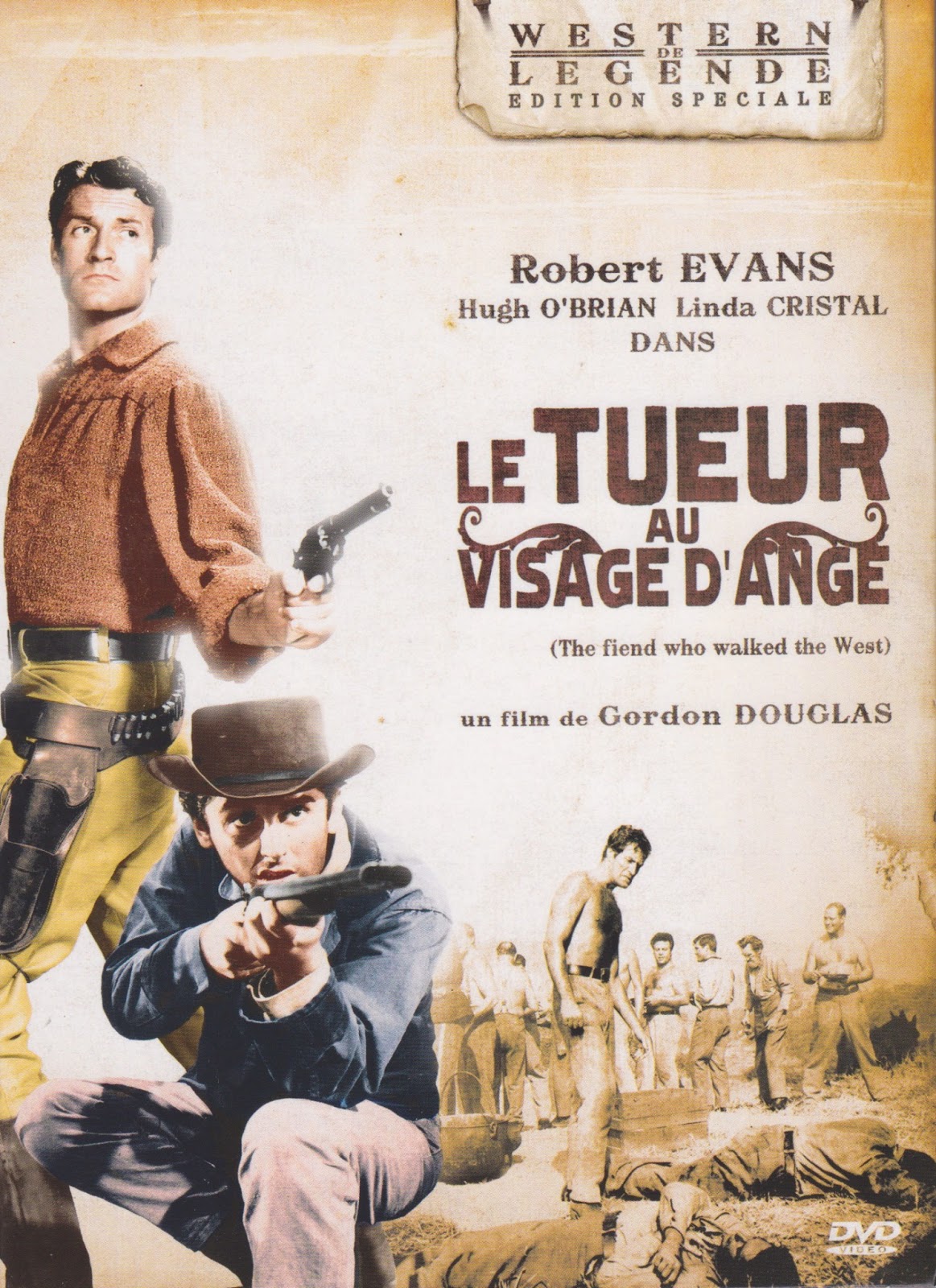
Daniel Hardy (Hugh O'Brian) is desperate to secure a financial future for his growing family, so he joins a group of bank robbers. However, the robbery fails to run to plan when Daniel is locked in the safe and arrested, and Daniel's life plans go further awry when he is jailed for ten years rather than the expected shorter prison term he expected as a first-time offender.
Things go from bad to worse when his fellow gang members - whom he has refused to name - fail to provide his family with his expected share of the loot and as he gradually discovers that his young cellmate Felix Griffin (Robert Evans) is an unstable psychopath who exacts a fearful revenge on those who lay their hands on him. However, Felix has plans of his own and, after he discovers the identity of Daniel's gang leader, he decides to secure the loot for himself following his release from jail; which he proceeds to do in murderous fashion. With Daniel on the inside and Felix raising hell on the outside, a plan is hatched by the authorities to ensure that Felix pays for his crime. It's a plan that involves Daniel and his family in a deadly game of cat and mouse.
It's Kiss of Death out West as this first remake of the 1947 film noir classic rides the range (there is also a 1995 version starring Nicolas Cage in a scenery-chewing performance as the psychopath whilst David Caruso portrays the similarly slightly tarnished hero). And it's a far more interesting film than it's lowly reputation leads one to believe (a reputation probably due in no small part to a highly misleading advertising campaign from title through poster and trailer that predominantly sell the film as a Western / Horror film hybrid, and which is also cued up by the film's opening titles theme that segues from traditional Western to seemingly supernatural).
Often broodingly shot by experienced DOP Joseph MacDonald, who had previously worked on both Westerns and noirs like My Darling Clementine, Call Northside 777 and Panic In The Streets, and solidly directed by experienced director Gordon (Them!) Douglas from a Harry Brown / Philip Yordan script derived in part from Ben Hecht and Charles Lederer's 1947 script for Kiss of Death (which was itself based on a novel by Eleazar Lipsky), the film is actually a surprisingly successful blending of the style of more adult 1950s psychological Westerns like 3:10 To Yuma and Jubal and the noirish crime cycle that began in the previous decade as the forces of law and order deploy unconventional methods to stop a dangerous criminal in his tracks.
For those aware of the film's derivation, there's a neat and intentional misdirected Kiss Of Death homage in a scene where Griffin encounters the criminal gang-leader's larcenously-inclined wheelchair-bound mother, although the pay-off here reflects the different genre, and, particularly, in Evans' performance in which he occasionally seems to be channelling Richard Widmark's performance in what are often some of the film's least successful moments. It's worth noting that Evans' performance - which the man himself has negatively commented on in his entertaining, if rather self-serving, memoir The Kid Stays In The Picture (both the book and the film adaptation) - is nowhere near as bad as either he, the trailer (in which he gibbers and snarls like a hopped-up 50s juvenile delinquent in scenes that do not feature in the film) or the film's reputation might lead one to believe.
True, the occasional eye-rolling and snarling close-ups contain far less credible menace than Widmark's seminal Tommy Udo. But, in the film's quieter moments and also where his psychotic behaviour is implied rather than played out on screen (the fate of a chain-gang convict who has foolishly previously crossed his path as well as that of a docile and seemingly traumatised female companion who has undoubtedly been subjected to unseen brutality are chilling for what is suggested rather than shown) and where he toys with O'Brian's square-jawed and more instinctive traditional Western hero show that he was a far more accomplished actor than either he or critics within and outside the industry (many of whom resented his seemingly smooth accession to lead actor ranks over others who had toiled for longer and with less success) have been prepared to admit.
The film also balances Evans' more showy moments with solid supporting performances from O'Brian (who was better known at the time for playing Wyatt Earp in the long-running TV series The Life And Legend Of Wyatt Earp), Stephen McNally, Dolores Michaels (who subsequently starred in the unusual and little-seen Alan Ladd revenge Western One Foot In Hell), Linda Cristal (as O'Brian's wife and who achieved more notable success in a similar role in TV Western series The High Chaparral), snarling stalwart Emile Meyer ('fat cop' Harry Kello from Sweet Smell Of Success) and future TV Tarzan Ron Ely as a Deputy with a hair-trigger temper.
Overall, it's a film undeserving of its consignment to date to a critical backwater and, hopefully, this sharp French DVD 2:35:1 transfer that maintains the original Cinemascope ratio (and which is English language with forced French subtitles) may herald a US or UK release, possibly with a subtitled version of the two add-ons, one of which features French director Bertrand Tavernier who - based on my limited understanding of the French language - appears to be providing some long-deserved critical rebalancing. It's certainly no masterpiece, but there's much to recommend it, and far more than the laughably conceived trailer that also features on the disc.
AFTERWORD: Now that you've seen what is probably one of the reasons why the film is generally held in such low regard, please check out the film. I don't think you'll be disappointed.
Someone is killing female hitchhikers on a lonely stretch of road outside a small Australian town. Although the victims are all neatly stabbed below the breast bone, the murder weapon is unknown and the victims have so far been dumped on the police station tempts to taunt the local force. However, the latest victim (Delvene Delaney) is not left in the usual place and is instead dumped in a local cinema during an afternoon screening. Suspicion soon falls on two brothers, paraplegic Robert Gifford (George Mallaby) and his able-bodied brother Mark (John Waters, who is NOT the well-known film director) who has recently returned home from one of his frequent stints in the merchant navy. The brothers have a close relationship but, as suspicious Superintendent Cheadle (Ken Goodlet) begins his investigations, cracks start to appear as the persistent and diligent officer seemingly gets closer to the truth at the heart of the serial slayings...
Director Tim Burstall's 1975 Australian serial killer thriller, released in its native country on 1st January 1976, adapted from a novel by Russell Braddon (The Naked Island and The Year Of The Angry Rabbit, which was filmed as Night Of The Lepus) and which relocates the action from an English country house to an Antipodean setting, is a taut if rather overlong thriller that plays out mostly in broad daylight and predominantly in the Gifford's home; which lends the film a claustrophobic two-hander chamber piece feel for much of its running time.
Opening with a tense and atmospheric killing on a lonely road, Burstall winds the tension tight, aided by some fine performances from the two leads whose relationship remains the beating heart of the movie even as the plot bends over backwards to maintain the uncertainty as to the killer's identity (which, if truth be told, is not really that much of a mystery). And it's the brothers' often unlikely bond throughout the film that makes the film memorable as blood really is thicker than water in what is admittedly rather protracted, if tense, fare. The film even manages to excuse itself one or two plot contrivances or unresolved aspects (most notably, a bit of business with a letter that is only written to provide a necessary flashback and whose existence is never followed through in the narrative).
Overall, this is a worthwhile watch and a generally fine re-release package in a clean print and in its original aspect ratio (although the soundtrack is a bit iffy at times, particularly during the mournful and plaintive love theme sung over the opening credits). The film, which was seemingly Australian cinema's first foray into serial killer whodunit territory and a box-office hit in its native country, deserves to be better known and is highly recommended.
AFTERWORD: This standalone Australian DVD release is a more affordable and accessible release than its original inclusion as part of a long-deleted and almost impossible to find boxed set. I first saw the film several decades ago as part of a UK BBC2 TV season on Australian cinema back in the 1970s (Those were the days!) and was surprised how much of the film stuck in my mind over the years. Although British-born director Tim Burstall was better known as one of the pioneers of Australian cinema's 1970s breakout to global success through some often rough and ready sex comedies (e.g. Stork, Alvin Purple and Petersen), this films shows that he was no slouch in the thriller stakes and it's something of a pity that he never made much of a name for himself in this genre.
The special features on the disc include interviews with star John Waters, cinematographer Dan Copping and Burstall's son Dan, who was the camera operator (and whose inclusion is not mentioned on the DVD sleeve), as well as an effective and rather extended trailer and stills gallery backed by the theme song, with both of the latter elements revealing rather too much of the film's plot to be recommended viewing prior to watching the film itself.
Thirteen year-old Robert Struve is facially disfigured whilst riding a borrowed motor scooter which is struck by a car being steered by eight year-old Julie Horvard who is sitting on her father's lap. His impoverished mother settles for a low insurance pay-out and Robert completes his high-school education, where he excels as a football player. However, after he is invited to a sorority house initiation, he attacks Julie when he discovers he is the butt of a prank in which Julie and her sorority sisters Cathy, Dean and Lucia are meant to make out with him. Robert is sent to reform school where he finally receives plastic surgery to change his appearance.
Five years later, Dean is murdered in San Francisco shortly after telling her brother Carr that she has recently met Robert. Although her husband George confesses, Carr is convinced that Robert is seeking revenge for his earlier mistreatment and when it seems that the same killer is targeting the remainder of the female quartet, it appears that he may be correct...
This is the only novel written under the pseudonym Peter Held by Jack Vance (John Holbrook Vance) - an author more noted for his science-fiction and fantasy stories. In spite of the brutal but effective cover art by John Floherty and the front and back cover text, this is a murder mystery rather than an early serial-killer thriller, as much of the narrative focus placed on the character and motivations of the young women seemingly being lined up for the kill by a vengeful murderer as well as on the
identity of the killer.
The small-town setting with its formal collegiate rituals and codes of behaviour clearly belong to another time and place far removed from the contemporary scene, but these are nevertheless strongly evoked. So is the tension, which quietly builds, juxtaposing the murderous and the mundane - and the macabre - in a manner that keeps the reader off guard whilst rapidly turning the pages in what is a short, sharp and fast read.
There are some clever twists, including a major one which means this review must give away as little as the novel itself; even though it is one that has been oft-repeated since and most recently in a highly-regarded US TV show. Overall, this is a satisfying read, well-paced and written with a keen eye for detail and is therefore recommended if you're fortunate enough to find a copy.
AFTERWORD: And if you're fortunate enough to find an affordable copy of either the Pyramid paperback edition above or the original and extremely scarce 1957 Mystery House hardback you will be fortunate indeed. However, the book has since been republished under Jack Vance's name in a limited edition by Underwood-Miller in 1988 - which means copies seem to fetch extremely high prices - and also as The Flesh Mask (which is apparently Vance's preferred title) in a 2002 Vance Integral edition. My copy was more affordable as it was purchased as part of a job lot of Pyramid titles, and which at least made it relatively inexpensive compared to buying a single copy.
Jackson the ventriloquist (Eddie Constantine) is sentenced to twenty years in solitary confinement. However, prison bars cannot hold him for long and he quickly breaks out, returning to his Parisian haunts in search of a woman called Francoise whom he believes can provide him with an alibi. However, Francoise is shot and injured by gang members working for nightclub owner and criminal Simon. As she lies injured, Francoise tells Jackson to recover her daughter Sophie from a hotel room where she has been hidden. However, Simon's gang are on the trail, so Jackson and Sophie have to keep one step ahead of Simon and his gang whilst Jackson seeks to clear his name.
This is a lame, pedestrian and poorly motivated adaptation of Day Keene's superior crime novel Strange Witness (see previous entry). The tin-eared dubbing doesn't help, but it's the radical narrative alterations that hobble the film so that it limps to an unsatisfactory end. Setting aside the narrative ellipse at the start that fails to explain how Jackson breaks out of solitary confinement, one is still left with the red herring Sophie.
Rather than being a deux ex machina who could provide Jackson with the alibi to save him, Sophie serves no narrative purpose whatsoever, and neither does the large stuffed rabbit she insists Jackson buy for her; unlike in the novel where it provides for a key plot twist. Featuring one of the least exciting cinematic car chases, the type of wimpy hoods who hand over information after one light slap to the face, compliant women who find Hart so irresistible that they fall for his charms almost as soon as he opens his mouth and a plot that is mostly tell rather than show (the 86 minutes really do crawl by), and one is left with a highly unsatisfactory adaptation that fails to do any kind of justice to its fast-paced - if not exactly flawless - literary origins.
AFTERWORD: Although his literary output was prolific, Day Keene's work was not well-served by screen adaptations as surprisingly few of his books have been filmed. Apart from this film, Rene Clement's Les Felins (aka The Love Cage and Joy House), which was based on Joy House, and the Elvis Presley vehicle The Trouble With Girls, and which was adapted from Keene and Dwight Vincent's novel Chautauqua, are the best known. The film's Belgian poster - which I have scanned in from my collection - is more atmospheric and evocative than anything in the film, which is available as a VoD DVD-R from Sinister Cinema, and whose sound and image quality are serviceable enough.
Former nightclub entertainer Hart Jackson leaves prison after serving seven years a for a crime he didn't commit, having taken the rap for a frame-up that had ensnared his brother. Hart is now determined to kill the man responsible, Chicago crime lord and night-club owner Flip Evans. However, he rapidly becomes ensnared is a surprising series of events after meeting nightclub singer Thelma Winston, who claims she can clear Hart's name.
Thelma insists that Hart marries her before she is prepared to put in writing what she has told him, and she offers Hart some much needed cash with much more to follow if he agrees to her demand. the pair marry and arrive in Chicago, but they have been followed, Thelma is shot and badly injured and Hart is suspected of her shooting. Before going on the run, Hart is assured by Thelma that she hadn't set him up and is urged by her to take care of Olga, who is currently in a local hotel room. But who is Olga, what does she know and can she help Hart get out of his increasingly dangerous predicament?
This is a pacy, if slightly implausible, paperback original noirish crime melodrama that barely lets up from the first page and whose headlong narrative makes one overlook much of its narrative contrivance. The pieces all come together neatly - possibly rather too neatly - and there are also one or two clever twists, including one which I didn't see coming and had to turn back the pages to work out how it happened and whether it made sense (it does).
The bleak atmosphere of a seedy and Wintry Chicago is well-evoked within a novel where there is little or no narrative fat, the occasional violence is often realistic and painful and Keene spins a short, sharp,taut and twisty yarn with some flair and an eye for character, locale and a neatly turned phrase that keeps one turning the pages. Overall, it's a recommended read, if not perhaps one of its author's best.
AFTERWORD: Day Keene (real name Gunnar Hjerstedt) was one of the top paperback crime writers of the 50s. Having started in the pulps, Keene penned around fifty novels, as well as writing for film, TV, radio and the aforementioned pulp magazines. His books are generally distinguished by a direct writing style, and fast-paced - if occasionally implausible plots (I failed to mention that the hero of this one is also a ventriloquist whose voice-throwing skills have a direct bearing on the narrative and make him probably the finest exponent of his craft who never lived).
Many of his novels, like this one, feature a male protagonist on the run fighting to clear his name from a crime he did not commit and appeared between the covers of the popular paperback and digest publishers of the day (for example, Gold Medal, Graphic, Pyramid, Avon, Ace, Zenith, Lancer, Phantom Books). Author Bill Crider - who has written about Keene in far more detail and with more knowledge and insight than I can offer - is a fan and, if you read one or two of his 50s crime novels - some of which have recently been reprinted by the likes of Hard Case Crime and Stark House Press - I am sure you will be too.
This one has been reprinted by Macfadden Books in 1970 (an easier edition to find than the Graphic Books PBO) and in large print by Linford Library in 1991. It was also filmed in France in 1961 as Cause Toujours, Mon Lapin, with a dubbed DVD-R version (presumably the US release version) available from Sinister Cinema as Keep Talking, Baby (see the next entry).
One night, successful architect Paul Reeder sees a terrified girl running for her life in a quiet suburb. The problem is, he wasn't there at the time. Paul has only seen the crime after receiving images from a compact mirror he picked up after it was dropped by a woman in the foyer of his office building. And this fortunate - or unfortunate - intervention leads Paul to discover that he is psychic. However, his new gift - or affliction - involves him in a recent unsolved murder and a cast of characters including the members of a hippy cult that doesn't appear to practice peace and love, a reluctant witness and a killer (or killers) who resent the appearance of an amateur detective with a seemingly other-wordly gift.
This early 70s murder mystery whodunit promises much but delivers little. The psychic aspect of the plot is never explained and is apparently randomly acquired. So, instead of adding an exciting extra dimension to the narrative this merely results in Paul attempting to get his hands on some trinket or other in order to receive a psychic charge and advance the stuttering plot. This means the novel is repetitive and pedestrian and also becomes progressively less interesting given the similarity of these narrative building blocks.
It's possible this might not matter as much if the characters were quirky, vivid and leapt off the page - or if the author worked hard at evoking a time and place in which to immerse the reader. Unfortunately, the characters are cardboard, and location and incident bland to the point of tedium. So, in spite of a neat and rather cynical twist in the tail - which was a not uncommon narrative device at the time - there is little to engross or entertain and even less of a charge (psychic or otherwise) to convince the reader that there is more to this formulaic whodunit with a fantasy twist than meets the eye.
AFTERWORD: I was previously unaware of author Robert C. Dennis, but some amateur online sleuthing - unaided by any psychic insights - reveals that his literary career was far eclipsed by his screenwriting career. This was both lengthy and prolific, lasted from the early 50s until his death in 1983, and predominantly involved TV series like Alfred Hitchcock Presents, The Untouchables, The Outer Limits, Hawaii Five-O, Kojak, Charlie's Angels and T.J. Hooker.
Unfortunately, this novel exhibits the worst aspects of stolid and stereotypical TV genre writing of the day and the author's predominant employment in TV scriptwriting suggests that this was his strength. This UK paperback edition (there was an earlier UK Gollancz hardcover) was acquired for pennies rather than pounds along with a batch of 60s and 70s UK horror paperback fiction at a sadly since closed local charity shop. It boasts evocative - if slightly cheesy - uncredited artwork which suggests the book is a stalk and slash horror novel rather than this disappointing and forgettable whodunit.
Donald MacIvers (or 'Mac', as he is known to his friends) is scared. A Harvard drop-out hooked on drugs, booze and sex, Mac has been indoctrinated into a murderous cult influenced by Charles Manson. This cult of killers murder at will and at random in 'a war to the death, a fight to the finish' fuelled by the deranged belief that this will initiate an anarchic free for all from which they will emerge triumphant and omnipotent. Led by the diminutive Crazy Mary and assisted by her her murderously adept sidekick Esmerelda, the cult have pushed Mac to the end of his tether and a point at which he will no longer participate in their murderous plans. So, seizing on the chance to flee, Mac makes a run for it. However, he soon finds that the cult's tentacles stretch far and wide, and that not even help from such unlikely sources as a wealthy gay pick-up, an amenable young prostitute or even organised crime can seem to shake his former associates from their vengeful path...
An exploitative, sleazy 70s urban chase thriller scribbled in the shadow of symbol of the 60s meltdown. This dubious effort is a grimy, melodramatic and fast-paced 'X'-rated race through a nightmarish night-world that occasionally releases a seemingly authentic 42nd Street Grindhouse odour reminiscent of the celluloid revenge epic The Exterminator (1980). Ludicrously pitched to an almost hysterical - and often hysterically reactionary - level of heightened realism, this evocation of society's squalid underbelly is undoubtedly effective and the novel is undeniably a page-turner. However, it is also ludicrously implausible with the pursuing cult members inexplicably able to repeatedly reach their tentacles into Mac's most obscure hiding places without any plausible explanation, beyond the fact that Manson himself may be supernaturally divining Mac's whereabouts and telepathically communicating them to his deranged acolytes from his San Quentin prison cell.
The sexual politics of the book are hardwired to the times it was written, and the grisly fate of a knife-wielding female cult member who is shot by Mac several inches lower than her knife hand tells the reader all one needs to know about the ideologically soundness of the narrative set-up in which its female characters are at worst psychotic nymphomaniacs and at best helpful hookers. However, this determinedly downbeat tale actually plays out like a more graphically violent, sexually explicit and overtly misogynist update on a 50s Gold Medal original template spliced with The Fugitive.
So, for those who wish to be transported back to the world of seamy 70s paperback originals, this undoubtedly provides a couple of hours of rough hair-chested macho thrills; and is certainly the type of generic throwback which wouldn't stand a chance of getting published in these more politically correct times.
AFTERWORD: This is a curious package insofar as the cover blurb ('The horrifying revelations of a fiendish, sadistic murderer') and artwork featuring a well-drawn and convincing likeness of Charles Manson lording it over a poorly rendered sacrificial rite that may have been produced by a different artist suggests that this may be another non-fiction cash-in on the notorious real-life crimes associated with Charles Manson and his 'Family'.
The back cover also suggests that the novel may be derived from real events ('The author, formerly a member of the group, now in hiding, has revealed that the worst fears of the police were true. This is the whole sordid story'), although it also refers to the cult 'killing the female actress in a S&M flick'; an incident which does not even feature in the book.
Given this misdirection and the fact that I have been unable to ascertain anything about author Donald MacIvers beyond the fact that he is accredited with an introduction to a 1973 Leisure Books title Kothar - Barbarian Swordsman by Gardner F. Fox, this curious tangential addition to post-Manson literature is best enjoyed less for its tenuous links to that subgenre and more for its grubby generic thrills.
Mrs. Willie Hogan is a bored resident of Ouichita Road, Quivera. Her seemingly rather dull husband Howard is wealthy enough to enable her to live comfortably, but she responds by taking a series of lovers to alleviate the small-town tedium. However, after being goaded one night by an exasperated Howard, Willie shoots and kills him. Now, she has to turn to Howard's cousin, the similarly bored but far smarter Quincy - with whom she has also been dallying - in order to get rid of her husband's corpse and provide a plausible explanation for his sudden disappearance. However, the apparently perfect plan swiftly begins to fall apart as the flaws and foibles of the small-town cast of characters are peeled away.
Fletcher Flora's 1961 novel is a short, sharp and punchy tale exposing the hypocrisies of affluent post-War America. Set amongst an often amoral middle-class milieu of louche country-club types for whom every hour seems to be cocktail hour, Flora subverts many generic expectations. For one thing, Willie is far from the conniving femme fatale one first suspects her to be and is instead rather dense and unable to plot herself out of her predicament. Her apparent salvation - or partner in crime - is far from being the strapping everyman type and is instead a rather dissipated seducer with a sharp understanding of human psychology. He and all the other male characters are also similarly flawed in being so taken with Willie's child-woman beauty that their moral compasses are all, to a degree, tilted out of whack and bear directly on Willie's ultimate fate; seemingly even beyond the final page of the novel.
Therefore, although ostensibly a hard-boiled crime novel with more than its fair share of twists and turns and characters emerging from the woodwork to seemingly thwart the protagonists' larcenous ambitions, the primary jabs here are often more satirical than generic with the author laying bare the often seemingly broadly drawn characters' flaws with a keen sense of moral disgust.
Overall, this is an impressive and well-written novel that rather ambushes the reader with its concealed intent, as well as being one with a cynical wrap-up that marks a shift from the generally re-established moral order of the 1950s crime novel to the more questioning decade that lay ahead.
VERDICT: Relatively wonderful.
AFTERWORD: This is the first novel I have read by an author I was previously more familiar with through reading his short stories in various crime digests of the '50s and '60s (e.g. Manhunt, Alfred Hitchcock's Mystery Magazine). On the basis of this one, he's certainly a canny stylist whose other novels - which seem to be none too tough to find online - warrant further investigation.
Pete Wells is an American in a tight spot in post-war Cairo. Relieved of his wallet and bereft of cash after a night on the town, he willingly falls in with a dissolute Englishman called Hastings and Helene, Comtesse de Rastignac, a larcenous pair who offer him a means of financial resolution from his imperilled situation. They persuade Pete to act as a courier for a valuable relic which he must collect from Luxor and return to them in Cairo, from where it can be spirited out of the country. However, a persistent and seemingly corrupt local police officer is following Pete, who soon discovers that obtaining the valuable relic and returning it to his current employers may be more difficult and dangerous than he could have imagined; especially after he falls for a beautiful blonde German singer called Anna whose connections to the country's ruler could precipitate even greater uproar and bloodshed.
What appears to be a formulaic if colourful and adventuresome Gold Medal paperback original is lent added spice by the fact that 'Cameron Kay' was a pseudonym for Gore Vidal. This means that the writing is both smoother and more polished, but also less gritty and hardboiled, than many of the publisher's usual offerings and lends the book greater interest than its rather routine subject matter might otherwise suggest.
Unsurprisingly, given his subsequent novels, the young Vidal seems to have more interest in the psychology, corruption and occasional lustful inclinations of the supporting cast than in the plotting or pace, with many of characters seeming more the kind of archetypes readily found in films of the day like Casablanca and Sirocco (for example, in terms of appearance and character Hastings appears to have been strongly based on Sydney Greenstreet). Wells himself is essentially a two-fisted caricature stumbling and fighting his way through a narrative of double-crosses and deceit and the third person narrative means that there is little sense of getting inside his head or, indeed, the story.
So, although this moves at a rapid clip and features some often interesting incidental detail - particularly sexual (as well a climax involving a revolt in Cairo that unwittingly possesses greater contemporary resonance), were it not for the interesting provenance this would otherwise be a competent if throwaway example of its publisher's prodigious and often more impressive output.
VERDICT: O-Kay
AFTERWORD: Apparently, Gore Vidal refused to sanction any reprints of this book. This means that this is the only US edition and, along with its even more uncommon UK Red Seal edition (No.58, 1956), is seemingly tough to find - especially in shape. Consequently, given its scarcity and desirability, it commands rather high prices from online dealers who are aware of the identity of the author hiding behind the pseudonym.
Allan Colleigh has been partially blind for several months following the death of his father in a house fire and he now suffers from 'hysterical blindness', a possibly temporary condition directly linked to the trauma and one that could possibly be reversed by a similar shocking incident. He lives with his sister Katherine in an old Gothic house near to the university campus where his father lectured and also receives occasionally care and attention from their neighbour Olive. Allan is troubled by a number of occurrences that appear linked to the arrival of a barely glimpsed male student lodger who appears to keep irregular hours, and this triggers his increasing paranoia as he begins to suspect that someone - or something - intends leading him to his doom.
The reader shares Allan's increasing apprehension and growing terror through the first person narration which effectively maintains the level of uncertainty until the final twists. Author Henry Farrell's best known novel - and the one which the cover blurb reminds us of - was Whatever Happened To Baby Jane and this novel similarly features two female characters who may hold the key to unlock the narrative resolution. The blindness metaphor blurs the sense of illusion and reality and similarly obscures the truth from the reader, and the tension is also generally kept at a high level as the author makes the cold, creepy and creaking house with its dark recesses and hidden secrets a forbidden character that seems to possess a life of its own.
Less satisfying is the twist in the tail which relies on aspects of character and appearance not being revealed to Allan throughout the novel. It also includes a lazy plot device involving an inscribed book that is neither satisfactorily nor credibly handled.
Overall, this is a well-written psychodrama, albeit one that would have benefited from some tighter plotting.
VERDICT: Not awful, just average.
AFTERWORD: The author subsequently adapted the novel into a 1970 teleplay which was directed by Curtis Harrington (see Games below) and starred Anthony Perkins as Allan, Julie Harris as Katherine and Joan Hackett as Olive. Given that it jettisons most of the first person perspective save for some blurry scenes where Allan is menaced by person or persons unknown, the narrative takes a far more conventional path. Much of the claustrophobia and chilly tension is dissipated and the brief running time also means it never really works up a head of steam so as to function as an effective psychodrama. However, it is well-played by a surprisingly strong principal cast, although it still can't resolve the unsatisfactory inscribed book plot device. The film appears to be widely available on various budget DVD labels.
Paul and Jennifer Montgomery (James Caan and Katharine Ross) are wealthy socialites who live on New York's East Side in a house decorated with pop art paintings and sculptures and Victorian paraphernalia. The keep themselves amused by staging quirky soirees and playing games, and soon involve an enigmatic older woman Lisa Schindler (Simone Signoret) in the latter when she is taken ill in their house and invited to stay. However, the games escalate from practical jokes and take an apparently deadly turn. But who is playing for keeps?...
Finally released on DVD in the US, albeit as a movie-on-demand DVD-R, this twisty 1967 thriller is an enjoyable, effective and suspenseful thriller. Much of the film takes place in the Paul and Jennifer's house, which lends the film a claustrophobic air but also occasionally feels studio-bound and rather stagey. That said, there are some effective twists (well, they worked for me, anyway) and although the presence of Simone Signoret as the mysterious Lisa intentionally evokes her ambiguous role in the earlier superior Les Diaboliques (The Fiends) and she is given less to do than her top billing suggests, a youthful James Caan and Katharine Ross effectively convey the sense of louche moneyed boredom that underpins the couple's desire for excitement and adventure.
Director Curtis Harrington handles the suspense effectively, with a body that won't stop bleeding as it rises and then gets stuck in an elevator being a notable Hitchcockian highlight. There's little here beyond an oddball opening party, the occasional modish pop art trappings and some playing around with mirrors and the notion of reflections to remind one of his avant-garde underground origins as this is by and large a slick studio thriller; albeit one with an ending that foreshadows cynical 70s film-making rather than seeming of a piece with 60s genre filmmaking. Nevertheless, it's a reminder that Harrington was one of the more underused talents of the times and one whose other cult films (e.g. Night Tide, Whoever Slew Auntie Roo?, What's The Matter With Helen?, The Killing Kind and Ruby) are well-worth seeking out.
VERDICT: Worth playing.
AFTERWORD: $20 or thereabouts for this movie-on-demand DVD-R is a high price which is just about worth paying for this bare bones catalogue title that would probably otherwise not be seen as worth releasing (although an off-air recording from, say, TCM would yield a similar product for far less outlay). There's also a seemingly common movie tie-in paperback by acclaimed 50s juvenile delinquency specialist Hal Ellson (see cover scan above) - although I have yet to read the book.
Clayton Biner is a would-be artist in his late 30s slumming it on the Mediterranean Riviera until one day he attempts to cash a cheque (or check as they say in the US) and discovers that the passport he presents to confirm his identity is not his own. This draws him into the first of his adventures in this book, and one that ends violently when he manages to rescue a heroin addict and extricate himself from a nightmarish scenario. As if this is not enough (we are only fifty pages in when this storyline is apparently resolved), the almost penniless Biner is subsequently persuaded to traffic a large quantity of heroin into the US. When his attempt to sell the heroin to his contact ends simialrly violently, Biner finds himself on the run from the Syndicate and has to forge a risky alliance with a female junkie as he attempts to make a score that will set him up for life.
Biner is an often amoral and generally dislikable anti-hero who narrates the tale in flashback with a jaundiced and cynical air. His contempt for humanity is, of course, a shield to attempt to protect himself from his own self-loathing, so that what emerges occasionally echoes Jim Thompson in its 'plague on all your houses' pitilessness and fatalistic narrative arc. The action is swift and the tale barrels along in clipped sentences, occasionally segueing into a stream of consciousness as we gradually discover what has transpired. The occasional burst of violence are also often graphic, seemingly foreshadowing the levels of realism that were soon to enter the cinematic mainstream (the book was written in 1963). And there's also atmosphere aplenty, from the seamier side of the Riviera settings in the opening section when various lost and jaded characters wash up to the seedy and sweaty desperate urban mileu of drinking dens and apartments inhabited by similar lost souls often hooked on narcotics that accelerate their spiral into despair.
Ed Lacy was a prolific author who had around thirty novels of mostly crime fiction published over a period of eighteen years before dying from a heart attack at the age of 56 in 1968. Born Leonard S. Zinberg, he is most often noted as the white creator of what is probably the first realistic and believable African-American private detective series character in Room To Swing (1957). As I own a copy of every novel he wrote, I really should have read more of them and aim to put that right very soon. In the meantime, this one comes highly recommended to fans of pacy hardboiled crime fiction.
VERDICT: A real shot in the arm!
AFTERWORD: This retitled reprint must have one of the blandest and most misleading covers of all time. More closely resembling a James Bond cover with its smartly suited and booted executive type taking aim at the reader as a scantily-clad blonde clutching a fur coat drapes herself over his shoulder, the artwork could not be further away from the reality of the tale within if it tried (although I suppose a cover sporting a dissipated failure with a heroin addict woman in tow may not have shifted many copies in the eyes of its publisher). The original 1963 publication as The Sex Castle is not much better as the shapely redhead with the strategically-placed towel taking a phone call on a rather old-fashioned looking device on the cover - and who does not resemble any of the book's female characters - and a back cover that inaccurately sells the would-be reader a world of 'swimming pools in California, haciendas in Mexico' indicates the same publisher was similarly uncertain of what they were selling or who they intended to sell it to. six years earlier.
I'll briefly summarise this one by paraphrasing Julian Symons' Sunday Times review that appears in part on the back cover, as to go into further detail risks giving away too much of the plot. 'The girl has been burned in a house on the French Riviera. Her companion, a girl of the same age died in the fire. Is the survivor Mi, the heiress, or Do, her adoring platonically lesbian companion?'
Sebastian Japrisot is a pseudonym of Jean-Baptiste Rossi, and this pseudonym is an anagram of the author's real name. The writing is stylish and witty, and even though the events in the novel are certainly far-fetched, they remain just this side of credible. The well-realised backdrops - particularly those set amongst the idle rich and which recall the French adaptation of Patricia Highsmith's The Talented Mr. Ripley, Plein Soleil (Purple Noon) - suggest a familiarity with the disdainful and morally compromised that gives the reader a strong sense of whom to root for, even though the payoff may leave a sour taste (and for those who think they have it figured out early on, there are a couple of surprises to catch you off-guard).
Riviera noir set predominantly amidst a sun-dappled locale, and recommended for those on the lookout for some continental 60s-set suspense.
VERDICT: In-Cind-iary!
AFTERWORD: As with many 60s noir and hardboiled titles, this Corgi paperback edition seems to be rather elusive these days (although I keep forgetting that books of this vintage are over forty years old, so there's no reason why they should still be plentiful). Some of the reprint editions also seem to be priced on the high side (the 1990 No Exit Press edition appears to be the most common and cheapest), but an English language film adaptation directed by Iain Softley is due to be released in late 2012, so a movie tie-in edition may be in the offing (NB There was an earlier 1965 French language adaptation that does not appear to have been released on video or DVD or translated into English).